
The drive from Cancún to Bacalar covers roughly 340 kilometres down the length of Quintana Roo, from the state's busiest international gateway to one of its quietest waterfront towns. Most travellers never make this journey — they fly into Cancún, stay in the Hotel Zone or Tulum, and leave without seeing the southern half of the state. That is a mistake. The road south connects the polished resort corridor to the Costa Maya, a stretch of lagoon, jungle, and small Maya towns that feels like a different country from the all-inclusive strip you left behind.
This guide covers the full route: drive times, where to stop, what the road is actually like, and how many days to give yourself.
The Route at a Glance
The entire journey runs along Federal Highway 307, the two-lane road that serves as Quintana Roo's spine. It is a libre (free) federal highway — there are no toll booths on the Quintana Roo section between Cancún and Bacalar. The road is entirely flat, running through low-lying karst jungle, with occasional glimpses of turquoise water through the trees.
| Segment | Distance | Drive Time |
|---|---|---|
| Cancún → Playa del Carmen | ~68 km | 1 hour |
| Playa del Carmen → Tulum | ~65 km | 45 min – 1 hour |
| Tulum → Felipe Carrillo Puerto | ~100 km | 1.5 hours |
| Felipe Carrillo Puerto → Bacalar | ~110 km | 1.5 hours |
| Total | ~340–345 km | ~4.5 hours |
Those drive times assume clear traffic and no stops. In practice, leaving Cancún during morning rush hour can add 30–45 minutes before you clear the Hotel Zone. Factor in fuel stops, a meal, and a cenote break, and the journey takes a full day if you push through.
Road Conditions and What to Expect
Highway 307 is generally in reasonable condition between Cancún and Tulum, where the heaviest tourist traffic keeps maintenance a priority. The section between Cancún and Playa del Carmen was rehabilitated in recent years and is wide, well-marked, and smooth. South of Tulum, the road narrows slightly and you will encounter more topes (speed bumps) approaching towns and villages. These are often poorly marked — slow down whenever you see a town sign.
The Bacalar municipality section received a dedicated rehabilitation in early 2026 (17.7 million pesos invested in a 5-kilometre stretch), but reports of potholes and uneven surfaces still surface on other segments, particularly after the rainy season. Drive at a steady pace, especially at night, when the road is unlit and wildlife crossings are common.
Fuel up in the larger towns. Gas stations are frequent between Cancún and Tulum but become sparse south of Felipe Carrillo Puerto. Fill your tank in Tulum or Felipe Carrillo Puerto before the final push to Bacalar. Stations accept cash and card, but some rural locations operate cash only — keep 500–1,000 MXN in small notes as a backup.
Military checkpoints are common along Highway 307, particularly south of Tulum. These are routine. Pull over when directed, have your licence and vehicle registration ready, and answer questions politely. The stops typically last two to five minutes.
Why Drive Instead of Flying or Busing?
The alternatives are straightforward but limiting. ADO runs direct buses from Cancún to Bacalar (approximately 5–5.5 hours, around $17–50 USD), but you cannot stop at cenotes, pull over for roadside tacos, or detour to Muyil. Flying requires connecting through Chetumal or Mexico City and still leaves you needing ground transport to Bacalar itself.
A rental car gives you the flexibility to break the journey, explore the stops that interest you, and carry gear (snorkels, coolers, beach bags) without luggage restrictions. For a road trip, it is the only option that makes sense.
If you are renting, book from a reputable agency and purchase full insurance coverage. Mexican law requires liability insurance from a Mexican-licensed provider — your U.S. or Canadian policy is not valid for damages you cause. Read the rental agreement carefully; the upsell at the counter is aggressive, and the fine print matters.
Stop 1: Puerto Morelos (30 minutes off the highway)
The first logical break is Puerto Morelos, 35 kilometres south of Cancún. This small fishing town has resisted the mega-resort development that transformed its neighbours, and it makes a calm place to stretch your legs. The Ruta de los Cenotes branches off the highway here — a jungle road lined with smaller cenotes like Verde Lucero, Siete Bocas, and La Noria, where entry fees run 100–200 MXN and crowds are a fraction of what you will find at Dos Ojos or Gran Cenote.
If you are not stopping to swim, grab coffee and a marquesita in the town square and keep moving. Puerto Morelos works better as a brief pause than a full detour unless you are cenote-hopping.
Stop 2: Playa del Carmen (1 hour from Cancún)
Playa del Carmen is the largest town on the route and the last place with full urban infrastructure — shopping centres, pharmacies, ATMs, car rental return desks — before the road thins out. Most road trippers blow through here, but it is worth a stop for fuel and food.
The Quinta Avenida pedestrian strip is crowded and heavily touristed, but the side streets hold better value. For a quick, authentic lunch, the taco stands away from the main drag serve al pastor and cochinita pibil at local prices (80–150 MXN per person) rather than the 300+ MXN you will pay on Fifth Avenue.
If you are breaking the journey overnight, Playa del Carmen has the widest accommodation range on the route. But if your destination is Bacalar, push on — the stretch south of Tulum is where the road trip earns its keep.
GuideChichén Itzá Day Trip from Playa del Carmen: Transport, Tickets & What to SeeHow to visit Chichén Itzá from Playa del Carmen: transport options (tour, ADO bus, rental car), entrance fees, site highlights, and practical tips for a smooth day trip.Open
Stop 3: Tulum (1.5 hours from Cancún)
Tulum marks the transition point. North of Tulum, you are in the Riviera Maya resort corridor. South of it, the jungle closes in, the towns get smaller, and the tourist infrastructure thins. The ruins are the obvious draw — the clifftop Maya site overlooking the Caribbean is the most photographed archaeological location in Quintana Roo — but they require 2–3 hours minimum and a separate entry fee (around 95 MXN). If you have not seen them before, they justify a stop.
The cenote cluster around Tulum (Gran Cenote, Dos Ojos, Cenote Calavera) is the most visited in the state. By 10:00 AM these are crowded. If you want a quieter swim, save your cenote time for the less-visited options further south.
Tulum is also the last reliable place for ATMs, pharmacies, and large supermarkets before Bacalar. Stock up on water, snacks, and sunscreen here.
Stop 4: Muyil and the Sian Ka'an Biosphere (30 minutes south of Tulum)
Just past the Tulum junction, Highway 307 passes the turnoff for Muyil and the southern entrance to the Sian Ka'an Biosphere Reserve. This is the quietest section of the route and the one most travellers skip.
The Muyil ruins are small compared to Tulum or Cobá — a compact set of structures in the jungle, with a lookout tower that gives you a view over the lagoon system. Entry is inexpensive (around 75–85 MXN) and the site rarely gets crowded. More interesting is the boat tour through the Sian Ka'an lagoons, where you float through ancient Maya channels cut through mangrove. Tours run approximately 1,500–2,500 MXN per person and take half a day.
If you are not doing a boat tour, the Muyil ruins alone are worth a 45-minute stop. The jungle setting and lack of crowds make them feel more discovered than the major sites.
GuideMuyil Ruins in Sian KaMuyil is one of the oldest Mayan sites on the Yucatán coast, set inside the Sian Ka'an Biosphere Reserve just 20 km south of Tulum. Fewer crowds, a jungle setting, and the option to combine ruins with a canal float make it a rewarding half-day trip.Open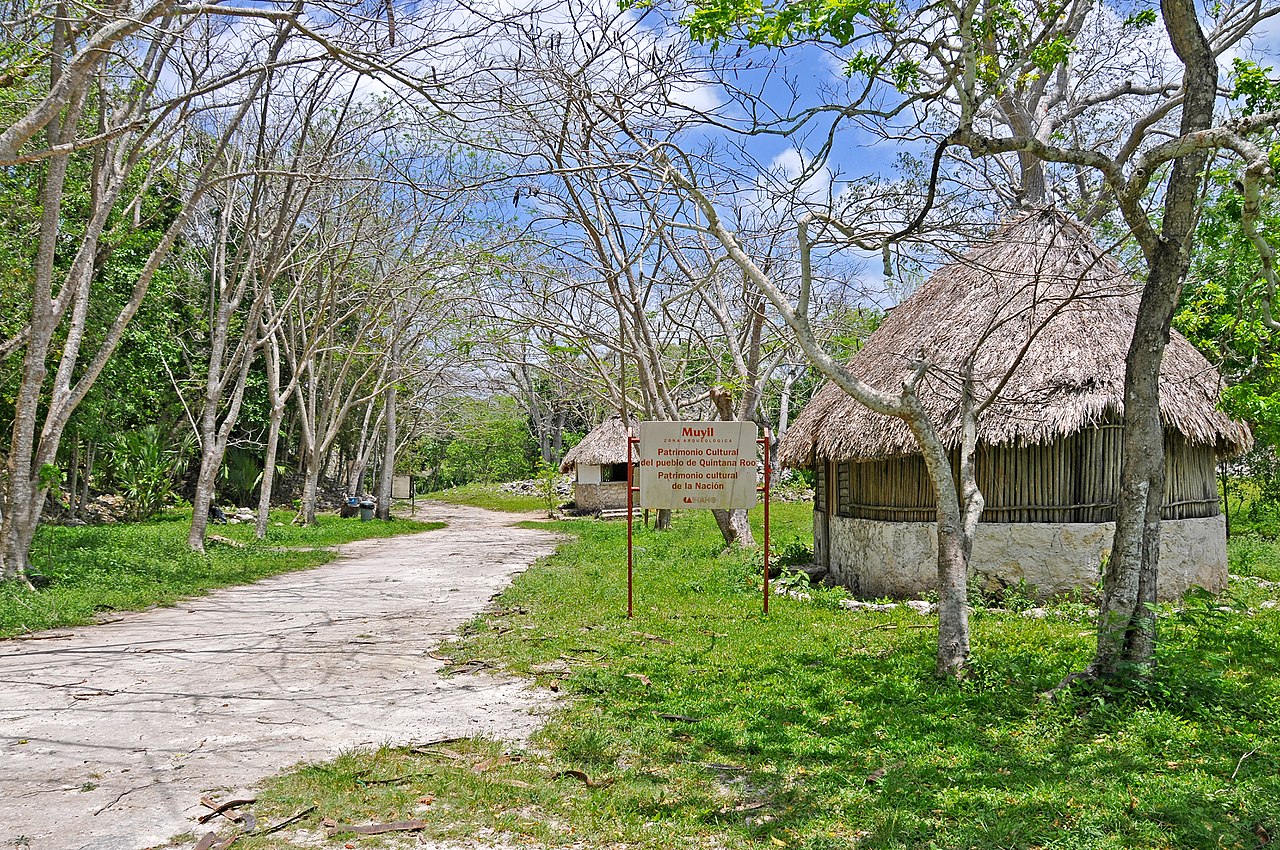
Stop 5: Felipe Carrillo Puerto (1.5 hours south of Tulum)
Felipe Carrillo Puerto is the last town of any size before Bacalar, and it is the most culturally distinct stop on the route. Founded as Chan Santa Cruz during the Caste War of Yucatán, it was the spiritual and political capital of the Maya resistance. The Talking Holy Cross — the sacred symbol that united the Cruzo'ob Maya — is still honoured here, and the town remains majority Maya-speaking.
This is not a tourist town in the conventional sense. There are no beach clubs, no boutique hotels, no Instagram murals. What you will find is a working Maya town with a central market, a few modest restaurants serving regional food, and a pace of life that has nothing to do with the coast.
Stop for lunch. The market area has simple comedores serving pollo pibil, relleno negro, and panuchos at prices that have not been adjusted for tourists (60–120 MXN). There is also a small museum — the Museo Maya Santa Cruz Xbaalam Naj — that covers the Caste War history. The town is also a gateway to lesser-visited cenotes in the surrounding jungle; operators like Báalam Nah run mountain bike and kayaking excursions into the nearby Sian Ka'an buffer zone.
Felipe Carrillo Puerto is the right place to fill your tank for the final leg. The next 110 kilometres to Bacalar have limited services.
Arriving in Bacalar
Bacalar announces itself with colour. The town sits on the eastern shore of the Lagoon of Seven Colors, a 42-kilometre freshwater lagoon that shifts from pale turquoise to deep navy depending on depth and light. The water is shallow near the shore and drops off sharply in cenote-like formations further out. The town itself has around 12,000 residents, no traffic lights, and a waterfront malecón that fills with locals at sunset.
 Bacalar Lagoon, Quintana Roo
Bacalar rewards slow time. A single day lets you see the lagoon from a kayak or the malecón, but the town and its surroundings deserve two to three days. The essential activities: a catamaran or sailboat tour of the lagoon (40–75 USD, half day), a visit to Fort San Felipe (the 18th-century pirate-defence fort on the main square, around 65 MXN entry), swimming at Cenote Azul (the deep open cenote 4 kilometres from town, 35–50 MXN, cash only), and a morning kayak to see the stromatolites — living rock formations that are among the oldest life forms on Earth.
Los Rápidos, a natural lazy river where the lagoon feeds into a channel, is the most popular swimming spot (150–200 MXN entry). The current carries you downstream through clear water flanked by mangrove. It is busy on weekends but quiet on weekdays.
Accommodation in Bacalar ranges from budget hostels in town (300–600 MXN for a dorm) to lagoon-front boutique hotels (1,500–4,000 MXN per night). Staying on the lagoon itself — with a private pier and morning swims from your doorstep — is the experience that justifies the drive.
How Many Days to Give the Journey
One day (direct drive): Possible but unsatisfying. You leave Cancún at 7:00 AM, arrive in Bacalar by early afternoon, and spend the rest of the day recovering from the drive. Only do this if Bacalar is the destination and you have separate days budgeted to explore it.
Two days (recommended minimum): Day 1: Cancún to Tulum with stops at Puerto Morelos and a cenote, overnight in Tulum or the surrounding area. Day 2: Tulum to Bacalar with a stop at Muyil and Felipe Carrillo Puerto, arriving by mid-afternoon. This gives you one full day in Bacalar.
Three days (ideal): Day 1: Cancún to Playa del Carmen or Tulum with a full cenote morning. Day 2: Tulum to Bacalar with Muyil, Felipe Carrillo Puerto, and a relaxed arrival. Day 3: Full day in Bacalar. This is the pace that lets you enjoy the journey rather than endure it.
Practical Notes
When to go. The dry season (November–April) offers the calmest lagoon conditions and the least rain-related road hazards. May to October is hotter, more humid, and brings afternoon downpours that can make the jungle sections slick. Bacalar itself is a year-round destination — the lagoon is freshwater, so sargassum is not a concern here, unlike the Caribbean coast.
Cash vs. card. Highway 307 itself has no tolls, but small towns along the route operate largely on cash. Cenote entrances, market meals, and rural gas stations often do not accept cards. Carry 1,500–2,000 MXN in small denominations for the journey.
Tren Maya. The Tren Maya now serves Bacalar with a station on the town's outskirts. If you prefer not to drive the full route, you can take the train from Cancún (or any intermediate station) to Bacalar and rent a car locally for lagoon exploration. The train journey is longer than driving but removes the stress of navigating Highway 307 yourself.
Safety. Highway 307 is a standard federal road, not a danger zone. The usual precautions apply: avoid driving at night outside towns (unlit roads, wildlife, the occasional unmarked speed bump), keep doors locked in town, and do not leave valuables visible in a parked car. Bacalar itself is a quiet town with low crime rates — one of the safest stops on the route.
What this trip is not. This is not a luxury road trip. The road is two lanes, the towns are functional rather than picturesque, and the appeal is in the landscape and the cultural shift as you move from the international resort zone into the Maya heartland. If you are looking for polished experiences at every stop, stay on the coast. If you want to see the Quintana Roo that exists beyond the resort gates, point the car south and go.


