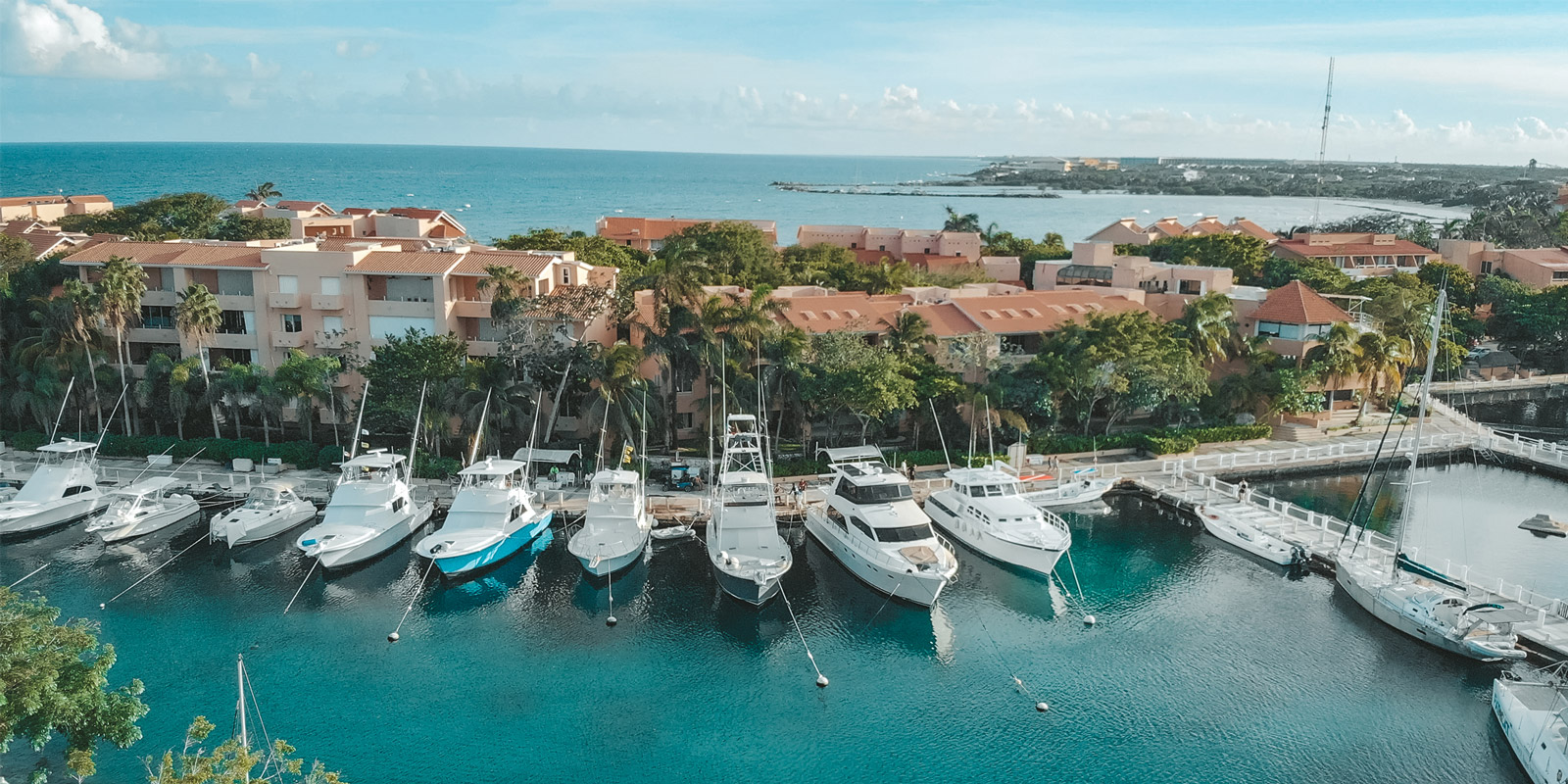
Paamul is easy to miss from Federal Highway 307. The turnoff is south of Playa del Carmen, the coast is screened by tropical vegetation, and the destination is not a large town with a busy central street. Instead, Paamul is a compact beachfront community arranged around a curved Caribbean bay, with a hotel, restaurant, dive operation, homes and a reef close to shore.
That small scale is the reason to come. Paamul can give you a quieter beach stop, a meal beside the water and a chance to snorkel or dive without committing to a full-day excursion. It is also the reason to plan carefully. This is not a wide municipal beach with an obvious public parking lot, a long promenade and a row of independent businesses. Practical access runs through a managed private community, and current arrangements for day visitors, parking, loungers and facilities can change.
The right way to think about Paamul is as a small beach-and-reef base on the central Riviera Maya, not as a guaranteed substitute for every beach farther north or south. Go when you are staying near Playa del Carmen, Puerto Aventuras or the central coast, confirm the current access before setting out, and keep a cenote or another beach as a backup if seaweed or wind changes the day.
 Paamul Bay viewed from the beach, with palms and the Caribbean shoreline
Paamul at a glance
Paamul suits travelers who value a contained bay, nearby services and informal reef activities more than a long, uninterrupted sweep of sand. Couples can make it a relaxed half-day. Independent travelers can combine it with Puerto Aventuras or another Highway 307 stop. Families may enjoy the short distances between the water, shade and restaurant, but adults need to inspect the entry carefully because rock, coral and uneven ground are part of the setting.
A quick summary:
- Where it is: On the Riviera Maya coast in Solidaridad municipality, south of Playa del Carmen and north of Puerto Aventuras.
- What it is: A small bay and beachfront community, not a large urban destination.
- Best for: A short beach outing, lunch by the sea, shore snorkeling when conditions are good, and travelers who prefer a lower-key setting.
- Less suitable for: Anyone expecting a broad public beach, guaranteed soft sand, a fully independent access route or a long list of businesses.
- Best transport: A rental car or a taxi arranged for both directions.
- Possible budget transport: A colectivo along the Playa del Carmen–Tulum corridor can stop near the highway entrance when requested, followed by a walk. This takes more confidence and is not ideal with children, luggage or limited mobility.
- Time to allow: Two to four hours for most day visitors; longer only if you have confirmed the facilities you plan to use.
- Water: The bay may be calmer than an exposed stretch of coast, but wind, current, reef and visibility still matter.
- Sargassum: Possible throughout the season and variable from day to day. Check recent conditions before leaving.
- Money: Carry pesos as a backup. Do not assume every service accepts cards or that beach facilities are included with entry.
There is no single “best” way to visit. A diver with a reservation has a different day from a family arriving for lunch, and both have a different experience from a traveler walking in from the highway. Confirming your purpose before you go makes Paamul much easier.
What makes Paamul different
The Riviera Maya has many beaches, but they do not all offer the same kind of day. Playa del Carmen is convenient and energetic. Xpu-Ha is known for a broader beach setting and beach-club options. Akumal is associated with a protected bay and regulated turtle experiences. Paamul is smaller and more residential in feel, with a reef-centered identity and a practical cluster of services around the shore.
The bay’s shape helps create that impression. Rather than presenting a long line of sand built for walking, Paamul gathers the visit into a more compact shoreline. Palms provide pockets of shade, and exposed limestone and reef areas appear alongside sand. The result can feel natural and sheltered, but it also means that the most comfortable place to enter the water may not be the most obvious place to sit.
Paamul’s appeal is strongest when you enjoy making a few decisions on arrival: where the bottom is sandy, whether the sea is calm enough to snorkel, whether the beach is clear of heavy sargassum, and which services are open to you that day. Travelers who want every detail fixed in advance may find that uncertainty frustrating. Travelers who appreciate a slower, less polished beach stop often find it worthwhile.
The offshore reef is central to the destination’s character. Local descriptions consistently emphasize snorkeling, diving and kayaking, and Paamul has an established dive operation associated with the beach. Reef access is not a promise of perfect visibility. It depends on wind, recent weather, seaweed and boat activity. Still, it gives Paamul more underwater interest than a beach chosen only for soft sand and sunbathing.
Where Paamul is on the Riviera Maya
Paamul is on the coast beside Highway 307, the main north–south road through the Riviera Maya. It is close enough to Playa del Carmen for a half-day outing and close enough to Puerto Aventuras to combine with a marina or nearby activity. From Tulum or Akumal, the drive is possible, but it makes more sense as one stop in a wider central-coast day than as the only reason to travel north.
This geography matters because Paamul does not operate like a downtown destination. You will not arrive at a large town center and choose between many restaurants, shops and public transport connections. The highway is the main reference point, and the final approach leads through a managed community toward the shore.
Use a current map pin and follow the signed entrance rather than relying on an old screenshot or an unofficial route through residential roads. Highway landmarks, signs and internal traffic arrangements can change. If you are taking a taxi, say Paamul clearly and confirm whether the driver will return for you. If you are using a colectivo, make sure you know which side of the highway you need for the return trip and where it is safe to wait.
Paamul is sometimes described as being “near Puerto Aventuras,” which is useful for orientation but does not mean the two destinations are interchangeable. Puerto Aventuras is a planned marina community with its own accommodation, restaurants and activities. Paamul is a smaller bay with a more limited service cluster. They work well together in an itinerary precisely because they offer different kinds of coastal stop.
How to get to Paamul
By rental car
A car is the simplest option if Paamul is one part of a day that includes several stops. Follow Highway 307 and use the current Paamul turnoff. Traffic, roadworks, rain and your exact starting point affect the journey, so allow more time than a map’s best-case estimate suggests.
The important part is not speed but the final approach. Slow down before the entrance, follow instructions from staff and ask where day visitors should park. Parking rules and availability are managed locally. Do not assume that an empty area is available for beach visitors, and do not block internal roads, resident access or emergency routes.
A car also gives you a useful fallback. If the bay has heavy sargassum or rough water, you can leave for a cenote, Puerto Aventuras or another planned stop without waiting for a taxi. The trade-off is that you need to drive attentively on a busy highway and protect the vehicle from valuables being visible inside.
By taxi
A taxi works well from Playa del Carmen or Puerto Aventuras, especially when you want to relax and do not plan several independent stops. Agree on the fare before leaving. Ask the driver whether they can wait, return at an agreed time or help arrange a return vehicle through the local hotel or restaurant.
Do not count on finding a taxi immediately at Paamul at the end of the afternoon. The destination is quieter than Playa del Carmen, and transport availability can be less predictable. If you are traveling with children, have a fixed dinner reservation or need to catch a ferry or airport transfer, arrange the return before you settle on the beach.
A taxi driver may know the entrance by the community name or by the highway kilometer. Carry the name in writing on your phone so there is less confusion, particularly if your Spanish is limited. Keep the contact details of the driver until you are back at your accommodation.
By colectivo
Shared colectivos operate along the Playa del Carmen–Tulum corridor and can stop near Paamul when you request the stop. This is the lower-cost approach, but it is not a door-to-door beach transfer. You will be dropped near Highway 307 and need to walk from the entrance toward the coast.
The walk can be manageable for an independent adult traveling light. It is less appealing with a stroller, a cooler, large snorkeling bags, beach toys or limited mobility. Heat and humidity make a short map distance feel longer, and the road environment deserves attention. Do not cross a fast highway casually. Use an established safe crossing point and ask local staff or your driver how visitors should return.
For the return, wait at the correct side and location rather than assuming every colectivo will stop wherever you stand. Ask the driver before boarding whether the vehicle is heading toward Playa del Carmen or Tulum. Basic Spanish helps: “Paamul, por favor” when requesting the stop, and “Playa del Carmen” or “Tulum” when confirming direction.
From Playa del Carmen
Paamul is a practical outing from Playa del Carmen because it gives you a smaller beach setting without requiring a long journey to the southern end of the Riviera Maya. A car or taxi is easiest. With a colectivo, plan for the highway walk and a less predictable return.
A sensible pattern is to go in the morning, assess the water and beach, have lunch if the service you want is available, and return to Playa del Carmen with enough daylight. You can then spend the evening in town rather than trying to find dinner and transportation at a small coastal community.
From Puerto Aventuras
Paamul and Puerto Aventuras are natural companions. You can spend the morning by the bay, then continue to the marina for a meal or an activity, or reverse the order depending on your reservation. A short taxi ride is generally more convenient than combining a walk and colectivo for this pairing.
Leave enough time for traffic and for the possibility that a beach stop takes longer than planned. If you book a boat, snorkel trip or dinner in Puerto Aventuras, treat that booking as the fixed point and visit Paamul only if the timing is comfortable.
From Akumal or Tulum
From Akumal or Tulum, Paamul is a northbound trip on Highway 307. It is feasible by car or taxi, but the distance makes a single-purpose visit less compelling unless you specifically want the reef bay or have a reservation. Combine it with another central Riviera Maya stop and avoid stacking too many time-sensitive activities.
Travelers staying in Tulum may prefer to focus on the beaches and cenotes closer to their base, while travelers with a rental car and a flexible schedule may enjoy comparing Paamul with Xpu-Ha or Puerto Aventuras. The point is not to collect beaches quickly; it is to choose the setting that matches the day you want.
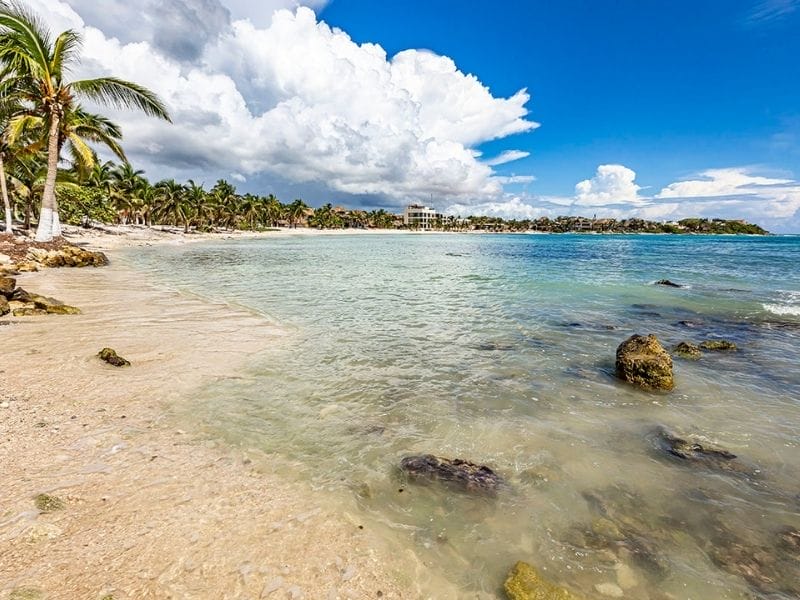 Palm trees and sandy shoreline at Paamul Beach on the Riviera Maya
Access, parking and the public beach question
Mexico’s federal maritime zone and beaches are public, but public shoreline does not mean that every road, parking area, bathroom, pool, lounger or restaurant behind it is free for unrestricted use. Paamul’s practical access passes through a privately managed hotel and residential setting. Day visitors should expect to identify themselves, ask where they may park and follow the current instructions.
That distinction prevents two common mistakes. The first is assuming that a private operator can simply erase public beach rights. The second is assuming that public beach rights guarantee free use of the operator’s infrastructure. Be respectful, ask rather than argue, and pay for services you use.
Before traveling, confirm:
- Whether non-guests may enter that day
- Where day visitors should park
- Whether parking has a current charge
- Whether restaurant or minimum-spend rules apply
- Which bathrooms and showers are available to visitors
- Whether loungers, shade or pool access are included or separate
- Whether the dive operation requires advance booking
These details can change with occupancy, maintenance, weather, private events or management decisions. An older blog post is useful for understanding the setting but not enough to establish today’s rules.
If you arrive and the conditions or access do not suit you, do not force the day. The Riviera Maya offers alternatives, and a calm conversation at the entrance is better than parking where you should not or treating residents as if their community were an open public lot.
What the beach is like
Paamul is a curved bay with a mix of sand, palms, limestone and reef. It is attractive in a low-key way rather than a grand, postcard-scale way. The compact shoreline makes it easy to move between shade, water and the restaurant, but the beach can feel narrow compared with Xpu-Ha or a long section of Tulum coast.
Sand depth and shoreline shape are not permanent. Storms, erosion, tides and seaweed alter the beach. Photos taken in a clear season can make the bay look more spacious than it feels on a particular day. Look for recent images if the exact beach experience matters to you.
The beach is not ideal for a long barefoot walk. Exposed rock and reef structure may make some sections uncomfortable, and the most attractive water entry may be on the sandier side of the bay. Water shoes are useful for travelers with sensitive feet, but they do not make it safe to walk across living coral. Enter through sand where possible and keep your feet off reef.
Natural shade is one of Paamul’s practical benefits. It is still wise to bring sun protection because shade moves and the available spots may be occupied. Rash guards, hats, reef-conscious sunscreen and a lightweight cover-up make a hot beach day easier.
Swimming at Paamul
Paamul can be pleasant for a swim when the bay is calm, visibility is reasonable and the entry is comfortable. A bay that feels sheltered from a straight stretch of coast can still have waves, current and uneven bottom. The reef changes the shape of the water, and boat or snorkel activity may affect where you should swim.
Before entering, stand at the edge and look at the bottom. Identify the sandiest route, check whether the water is moving across the entry and ask staff about current conditions. Keep children within direct reach rather than relying on the appearance of shallow turquoise water.
Do not swim out toward reef simply because the water looks clear. Snorkeling areas may have boat traffic, and a current can be hard to judge from shore. If you are not a confident open-water swimmer, use a guided service or stay in the protected part of the bay.
Paamul should not be treated as a lifeguarded pool. Ask whether a lifeguard is present and where supervision applies, but make your own safety decisions. Avoid swimming after heavy rain or when visibility has deteriorated. Leave the water if wind rises, thunder approaches or conditions change.
Snorkeling, diving and kayaking
The house reef is Paamul’s main reason for appeal beyond sunbathing. When the water is calm and clear, snorkeling close to shore can reveal reef structure and small fish without a long boat ride. The dive center can provide local information, equipment and guided options, and its staff are in a better position than a generic online post to judge the day’s visibility.
Ask specific questions before paying:
- Where is the safest entry today?
- Is the reef accessible from shore or is a boat required?
- What visibility should beginners expect?
- Are there current or boat restrictions?
- Is a guide included?
- What equipment is supplied?
- What happens if weather or sargassum makes the outing unsuitable?
A well-fitting mask matters more than expensive equipment. If you bring your own, test it before leaving home. Defog the lens appropriately, keep the strap comfortable and use a flotation aid if you are not a strong swimmer. Do not snorkel alone, and keep enough energy for the return to shore.
Kayaking can be a good way to see the bay from a different angle, but conditions still govern whether it is sensible. Wind can make a kayak difficult to control, and a reef area is not a place to beach or drag a boat. Follow the operator’s route and keep distance from coral and other water users.
Diving requires a higher level of planning. Use a recognized local operator, disclose your experience honestly and follow the briefing even if the water appears calm. Reef environments have overhead hazards, boats and changing conditions. Paamul’s small scale does not make diving casual.
Reef etiquette is straightforward: do not touch coral, stand on reef, collect shells, feed fish or chase marine animals. Keep your fins away from the bottom and leave wildlife room to move. A photograph is not worth damaging the place you came to see.
Sargassum and seasonal beach conditions
Paamul faces the Caribbean, so sargassum is always a possibility. The bay may look clear one week and have an unpleasant accumulation the next. Floating seaweed can reduce visibility, complicate water entry and create odor when it decomposes on shore. A reef does not guarantee protection from it.
Do not use a generic seasonal promise such as “Paamul is seaweed-free.” Conditions vary by wind, currents, recent arrivals, beach cleaning and the exact section of shore. Before leaving, check a recent photo, local report or direct message to the hotel or dive operation. A report from a neighboring beach is useful context, not proof of Paamul’s condition.
If sargassum is heavy, change the plan. You might visit Puerto Aventuras, spend time in a cenote, use a pool, explore Playa del Carmen or choose another beach with better same-day conditions. This is one reason not to prepay a long, inflexible day around Paamul unless the operator’s cancellation terms are clear.
Rain and wind matter even without sargassum. A cloudy morning can still be comfortable, while strong wind can make snorkeling poor. Storms may affect water quality and visibility. The best beach day is the one that matches the conditions, not the one that follows a rigid itinerary.
Food, drinks and facilities
Paamul’s convenient cluster of services is part of its appeal. The beachfront setting has been associated with a restaurant and bar, and local descriptions also mention a pool, convenience supplies and a dive operation. Availability, opening days, menus, payment methods and visitor access can change, so confirm directly if any one service is essential to your plan.
Think of the restaurant as a useful part of the visit rather than a guarantee that every traveler’s preferred meal will be available. Carry drinking water and a small cash reserve. Even where cards are accepted, connectivity or terminal issues can happen.
Bring your own basics:
- Water for the journey and time on the beach
- A towel and dry bag
- Sun protection and a hat
- Water shoes for rocky entries
- Pesos in small denominations
- A card as a second payment method
- Insect repellent for humid periods
- Any snacks or child supplies you need
- A phone battery pack if your return depends on a taxi
Ask before using a pool, lounger, umbrella, bathroom or shower. These may belong to the hotel or restaurant rather than being public beach facilities. Keep food covered, do not feed wildlife and take rubbish to the correct bins. Glass has no place on a beach, especially one with rocky entries.
Is Paamul good for families?
Paamul can work for families who want a compact outing with food and services close by. Parents do not need to carry supplies across a huge beach, and a calm bay can be enjoyable for older children who listen well around water and rocks.
It is not the easiest beach for toddlers who need a consistently soft, shallow, sandy entry. The bottom can be uneven, and conditions can change. Inspect the water before unpacking, keep a child within reach and do not substitute inflatable toys for supervision.
Confirm bathroom access, parking and shade before you go. A family beach day becomes much harder when the service you expected is restricted to hotel guests or when the only comfortable entry is farther along the shore. Pack lightly but deliberately: rash guards, dry clothes, water shoes and a dry bag are more useful than a large collection of toys.
If the water is rough, choose the restaurant or another activity rather than trying to swim because the journey has already been made. Paamul is close enough to other central Riviera Maya options that a backup plan is realistic.
Paamul for couples and independent travelers
Couples often find Paamul easiest as a slow half-day. Arrive in the morning, choose a shaded place if available, swim or snorkel when conditions cooperate, and have a meal by the water. The setting is quieter than Playa del Carmen without requiring the isolation of a remote beach.
Independent travelers should appreciate the same flexibility but should be more careful about the return journey. Keep your phone charged, carry cash, and do not wait until dark to solve transportation. If you are snorkeling, tell someone where you are going and use a guide if you are unfamiliar with the reef.
Paamul is also a sensible stop for travelers who are staying in a condo or villa and want a day that does not involve an all-inclusive resort. You can choose which services to use, but you need to ask what is included. The destination rewards curiosity and courtesy more than assumptions.
Accessibility and mobility
Do not assume that “beachfront” means step-free access from the parking area to the water. The community may have accessible rooms or routes to particular businesses, but that does not guarantee a continuous firm-surface path to the shoreline or a beach wheelchair.
Travelers with limited mobility should contact the property in advance and ask concrete questions:
- Is parking near the restaurant or beach access?
- Is the route step-free or does it include sand, steps or uneven rock?
- Can a wheelchair reach a firm part of the beach?
- Are bathrooms accessible to day visitors?
- Can staff explain the current water entry?
- Is there assistance available, and is it arranged in advance?
The answer can depend on tide, recent storms and the exact facility. Do not rely only on a general accessibility statement. If Paamul cannot provide the route you need, a more developed beach or an organized boat and snorkeling service may be a better fit.
Where to stay near Paamul
Paamul itself is associated with a beachfront hotel, residential homes, vacation rentals and an RV-oriented community. Staying locally can give you a slower coastal experience and remove the need to arrange a same-day return after dinner. It can also mean fewer independent shops and less transport flexibility than staying in a major town.
Ask accommodation providers about current access rules, restaurant availability, parking, housekeeping, internet reliability, air conditioning and whether the booking includes use of any beach or pool facilities. Do not assume that a room reservation includes every service in the community.
For more choice, Playa del Carmen is the practical base. It offers a wide range of hotels, restaurants, taxis and evening activity, with Paamul available as a day outing. Puerto Aventuras is closer and can suit travelers who prefer a marina community, arranged water activities and a quieter base. Akumal or Tulum may work if Paamul is one stop in a wider southern itinerary, but the extra driving is less convenient for a casual beach day.
Choose the base first, then decide whether Paamul deserves a visit. There is no need to stay at Paamul to enjoy its bay, and there is no need to make it the centerpiece of a trip if another beach better matches your accommodation and transport.
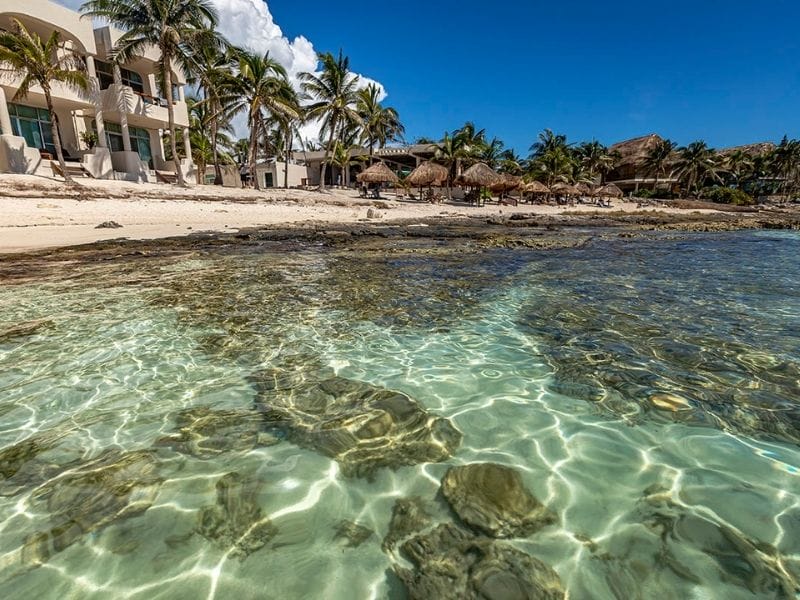 Paamul’s beachfront hotel and Caribbean water, viewed from the bay
How long to spend at Paamul
Two to four hours is enough for most visitors. That allows time to arrive, ask about access, inspect the beach, swim or snorkel if conditions are good, and eat or have a drink.
A full day can work when you have confirmed the services you want, found comfortable shade and the sea is inviting. It may feel repetitive if you are not diving, snorkeling or using the restaurant because the bay is small. Avoid scheduling a full day simply because an itinerary template says every beach needs one.
Morning is usually the most practical period. Temperatures are lower, the road and parking process are less stressful, and wind may be lighter before the afternoon, although none of these are guarantees. Weekdays may feel calmer than weekends, but hotel occupancy, local events and dive activity vary.
Leave a buffer if you are combining Paamul with another reservation. Highway delays, a slow lunch, a change in sea conditions or difficulty finding your taxi can all extend the stop. Never connect Paamul to an airport departure, ferry crossing or other non-flexible transfer without generous time.
What to combine with Paamul
Puerto Aventuras
Puerto Aventuras is the most natural companion. Its marina, restaurants and organized water activities create a different atmosphere from Paamul’s small bay. Visit Paamul first for a swim or snorkel, then continue to the marina, or use Puerto Aventuras as the fixed reservation and fit Paamul around it.
Keep parking and transport separate in your mind. A Puerto Aventuras plan does not automatically explain Paamul’s access rules, and a Paamul taxi may not be waiting when you are ready to move on.
Playa del Carmen
A morning at Paamul followed by an afternoon or evening in Playa del Carmen works well. You can use the beach for a quieter start and return to town for broader restaurant choice, shopping and nightlife. This pairing is especially useful when Paamul’s conditions are good enough for a short swim but not compelling enough for an entire day.
A nearby cenote
Cenotes provide the most useful backup when sargassum, rough water or poor visibility affects the coast. Choose one you have researched in advance, check its current rules and avoid trying to visit too many sites. A beach and cenote in one day can be enjoyable, but heat, changing clothes and drive time add up.
Xpu-Ha
Xpu-Ha is a better comparison when you want a broader beach setting, while Paamul is more compact and reef-oriented. Do not treat them as identical stops. If you have a car and current beach conditions favor it, you can compare the two, but give yourself enough time to enjoy one rather than rushing through both.
A dive or boat reservation
If you have booked an activity, let the operator’s meeting time control the day. Confirm the exact meeting point, equipment, cancellation policy and weather procedure. Paamul’s beach is a good place to build around an activity, but a casual visit should not jeopardize a paid reservation elsewhere.
Paamul compared with nearby beaches
Paamul vs. Playa del Carmen: Paamul is smaller, quieter and more reef-focused. Playa del Carmen is easier for transport, public-town services, evening meals and a broad choice of accommodation. Choose Paamul for a contained outing; choose Playa del Carmen for convenience.
Paamul vs. Puerto Aventuras: Paamul is the beach-and-bay stop. Puerto Aventuras is the marina-and-community stop. They are close enough to combine but offer different reasons to visit.
Paamul vs. Xpu-Ha: Paamul has a more intimate bay and established reef services. Xpu-Ha is generally the stronger choice when your priority is a broader sandy beach and a full beach-club day. Check current access and seaweed at both before deciding.
Paamul vs. Akumal: Akumal is known for its bay and regulated turtle tourism, with different rules and expectations around marine wildlife. Paamul is less centered on a single iconic animal encounter and can feel more informal. Choose based on whether you want a reef beach stop or a managed turtle-oriented experience.
Paamul vs. Tulum’s beaches: Tulum offers a larger tourism ecosystem, more restaurants and a long coastal zone, but access, traffic and beach conditions vary widely. Paamul can be simpler for a short central-coast outing, provided you are comfortable with managed access.
These comparisons are about fit, not rankings. A beach with perfect conditions today may be the wrong destination for your transport, mobility or schedule.
A simple Paamul day plan
Start by checking the beach and weather conditions, then contact the property or dive operation about day access and parking. Leave your accommodation with water, sun protection, pesos, a dry bag and a charged phone.
Arrive in the morning and ask where visitors should park and which facilities are available. Walk the beach before choosing a place to sit. Look at the water entry, the amount of sargassum, the wind and any marked swimming or boat areas.
If the sea is calm and the dive operation recommends it, snorkel from the appropriate entry or join a guided outing. If visibility is poor, do not treat a murky reef as a challenge. Swim in a safe sandy area, have lunch or move to the backup plan.
Keep the afternoon flexible. If you are returning by taxi or colectivo, begin arranging the journey before you feel ready to leave. If you are driving, continue only to a stop you have researched and can reach before dark.
Responsible travel at the bay
Paamul’s reef and shoreline are more valuable than any one photograph. Use established access routes, respect residents and hotel staff, and pay for the services you use. Do not remove coral, shells or rocks. Avoid single-use plastic where practical and take your rubbish with you if bins are full.
Use reef-conscious sun protection and shower before entering the water when a facility is available. Keep sunscreen, insect repellent and other products away from the water as much as possible. Never stand on coral, even if it looks like bare rock. Coral grows slowly and is easily damaged by fins, shoes and hands.
Give marine animals space. Do not chase turtles, feed fish or use flash close to wildlife. If a boat or guide sets a boundary, follow it. The best snorkeling behavior is quiet, buoyant and observant.
Respect the small community’s pace. Keep music low, do not photograph people or homes without permission, and ask before using private facilities. Public beach rights and local hospitality work best when visitors understand the difference between access to the shore and entitlement to every service behind it.
GuideBest Beaches Near Akumal: Your Guide to Akumal Bay, Half Moon Bay, Jade Bay, South Akumal & Xpu-HaDiscover the best beaches near Akumal, Mexico, from the turtle-filled waters of Akumal Bay to the tranquil shores of Jade Bay and the pristine sands of Xpu-Ha. This guide covers access, facilities, snorkeling opportunities, and practical tips for each beach.Open
Questions travelers often ask
Is Paamul a public beach?
The beach and federal maritime zone are public, but practical access, parking and facilities are managed locally through a private community. Confirm day-visitor rules and ask where to park. Public shoreline does not automatically mean free use of the hotel’s pool, bathrooms, loungers or restaurant services.
Can you visit Paamul without staying overnight?
Day visits may be possible, but current access rules can change. Contact the property or relevant operator before traveling, especially during busy periods or if you need parking or a particular facility.
Is Paamul good for swimming?
It can be when the bay is calm and the entry is comfortable. Rocks, reef, current, wind and sargassum can affect the experience. Inspect the bottom, ask about conditions and supervise children closely.
Can you snorkel from shore?
Paamul is associated with a house reef and shore snorkeling, but the practical route and visibility depend on the day. Ask the local dive operation where to enter and whether a guided option is advisable.
Do you need water shoes?
They are useful for travelers who dislike rocky or uneven entries. They do not make it acceptable to walk on coral. Enter through sand and avoid standing on reef.
Is Paamul free to enter?
Do not assume. The shoreline is public, but access arrangements, parking and use of private facilities may involve current rules or charges. Verify locally before setting out.
Is Paamul affected by sargassum?
Yes, it can be. The amount varies with wind, currents, season and recent arrivals. Check recent conditions rather than relying on a permanent claim that the bay is clear.
Can you get to Paamul by colectivo?
A colectivo can stop near the highway entrance when requested, but the final walk is less convenient than a car or taxi. Confirm the direction and return pickup point, and use extra caution around Highway 307.
Is Paamul worth a day trip from Tulum?
It can be if you specifically want the reef bay or are combining it with other central Riviera Maya stops. For a single casual beach visit, a closer Tulum-area beach or cenote may be more efficient.
What should you do if the water is rough?
Do not swim or snorkel simply because you have arrived. Ask about alternatives, eat or relax if appropriate, then switch to a cenote, pool or another planned stop. Conditions are a valid reason to change the day.
Paamul is at its best when you want a small, service-supported reef bay rather than a resort corridor or a long public beach. Confirm access, arrive with a flexible plan, inspect the water before swimming and keep a backup for sargassum or wind. If those conditions line up, Paamul can be an easy, unhurried coastal stop between Playa del Carmen and Puerto Aventuras—small enough to feel personal, but practical enough to fit into a wider Riviera Maya itinerary.
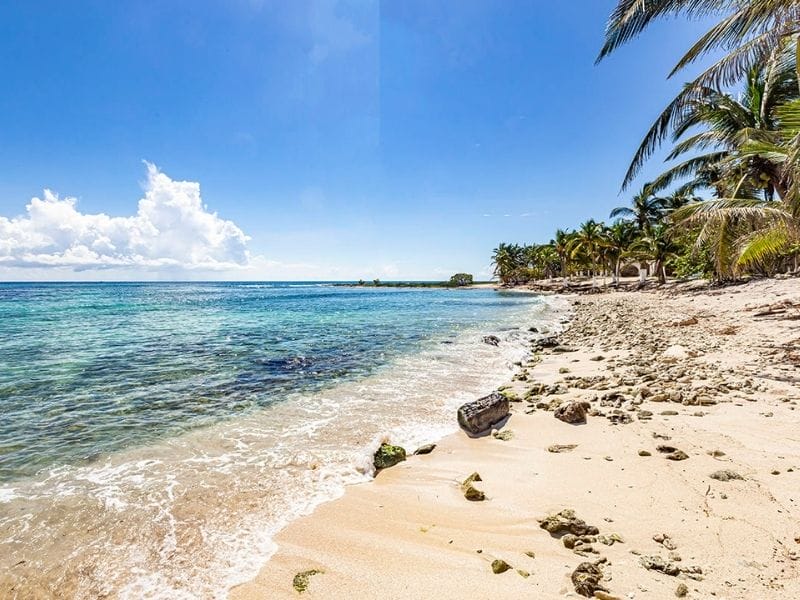 Rocky shoreline and blue Caribbean water at Paamul Beach
Choose Paamul when the bay itself, the nearby reef and a relaxed meal sound more appealing than a long list of activities. Choose Xpu-Ha when you need more open sand, Playa del Carmen when you want the easiest town services, or a cenote when the sea is carrying too much sargassum. That simple decision usually produces a better day than trying to make every beach fit the same itinerary.
With respectful access, realistic expectations and enough time for the return journey, Paamul offers a quieter side of the central Riviera Maya without pretending to be something it is not.