

The best cenote in the Riviera Maya is not necessarily the most photographed one.
A family travelling from Playa del Carmen may have a much better day at a shallow open cenote beside Highway 307 than at a dramatic cave reached by a long unpaved road. A certified diver may consider that same family cenote unremarkable. A visitor staying in Tulum can reach Gran Cenote before breakfast crowds arrive, while someone travelling from Puerto Morelos may spend half the morning getting there.
The practical question is therefore not simply which cenote is the best?
It is:
-
Which cenote suits the people in your group?
-
Is it better for swimming, snorkelling, diving or looking at cave formations?
-
Can you reach it independently?
-
Does the entrance involve steep stairs, deep water or narrow passages?
-
How much time will transport add?
-
Is the experience natural and low-key, or highly managed and commercial?
-
Is the price justified by what is included?
-
Will it still feel worthwhile when tour groups arrive?
This guide compares the strongest cenote experiences across the Riviera Maya, from the open pools south of Playa del Carmen to the cave systems around Akumal and Tulum, the inland route near Puerto Morelos, and the underground chambers near Cobá.
It also explains the geology beneath the coast, the historical importance of cenotes, realistic transport options, environmental rules, diving safety, costs, family logistics and how to build a day that does not feel rushed.
Sunlight entering Cenote Dos Ojos near Tulum
Best Riviera Maya cenotes at a glance
There is no single winner for every traveller. These are the most useful starting points.
| What you want | Best starting point | Why |
|---|---|---|
| Best overall cave and snorkelling experience | Dos Ojos | Clear water, large caverns and strong infrastructure |
| Best open-air swimming cenote | Jardín del Edén | Large natural pool with good snorkelling and space |
| Best for families with younger children | Cenote Azul | Shallow sections, gradual entry and straightforward access |
| Best classic cenote near Tulum | Gran Cenote | Easy to understand, close to town and suitable for first-timers |
| Best quieter cave atmosphere | Taak Bi Ha | Enclosed chamber, blue water and dramatic formations |
| Best unusual open-water experience | Casa Cenote | Long mangrove-lined channel connected to the coast |
| Best multi-cenote park | Kantun Chi | Several types of cenote in one organised property |
| Best premium guided underground tour | Río Secreto | Managed cave route with extensive formations |
| Best guided cave close to Playa del Carmen | Chaak Tun | Convenient for a structured half-day from the city |
| Best lower-cost open pool | Cristalino | Simple swimming experience close to Azul and Jardín del Edén |
| Best for a varied guided circuit | Chikin Ha | Open, semi-open and cave-like sections on one property |
| Best for a social jump-and-swim stop | Calavera | Small, distinctive and close to Tulum |
| Best natural open cenote near Tulum | Carwash, or Aktun Ha | Vegetation, deep water and a less polished atmosphere |
| Best managed circuit near Tulum | Casa Tortuga | Four cenotes and activities in one organised visit |
| Best inland cenote day from Puerto Morelos | La Noria, Kin Ha or Zapote | Useful anchors on the Ruta de los Cenotes |
| Best cenote to combine with Cobá | Choo-Ha | Enclosed chamber close to the archaeological zone |
| Best for certified cavern divers | Dos Ojos | Established guided cavern routes |
| Best for advanced cenote diving | The Pit | Depth, light beams and a pronounced halocline |
| Best when beaches have sargassum | Almost any inland cenote | Freshwater conditions are independent of seaweed on the coast |
Table of contents
How cenotes were formed
The flat surface of the Yucatán Peninsula hides one of the largest known concentrations of flooded caves on Earth.
The peninsula is largely made from porous limestone. Rainwater absorbs carbon dioxide from the air and soil, becoming mildly acidic. Over immense periods, that water passes through fractures in the limestone and gradually dissolves the rock.
Small openings become channels. Channels become chambers. Chambers connect into cave systems extending for many kilometres.
Some cave roofs eventually weaken and collapse. When the opening reveals the groundwater below, a cenote appears at the surface.
That simplified sequence explains the familiar open sinkhole, but it does not describe every cenote. Some remain almost entirely enclosed. Some have only a small opening in the roof. Others have lost most of their ceiling and now resemble natural ponds.
During colder periods of the Pleistocene, global sea levels were much lower than they are today. Many caves now filled with water were once dry. Mineral-rich droplets created stalactites, stalagmites, columns and curtains inside them.
As the climate warmed and sea levels rose, groundwater filled the lower passages. The formations remained below the surface, producing the submerged caverns now explored by snorkellers, archaeologists and divers.
Fresh water above salt water
The water beneath the Riviera Maya is not one uniform underground lake.
Rainwater filters through the limestone and forms a freshwater layer. Near the coast, denser salt water lies beneath it. Where the two layers meet, divers may see a blurred interface called a halocline.
Passing through it can make the water appear oily or out of focus. This is not pollution. It is the visual effect of waters with different salinity and density meeting.
The coastal cave systems also help explain why activities on land matter to the sea. Groundwater can move through the limestone toward coastal springs, mangroves and the Caribbean. Wastewater, chemicals and other contaminants introduced inland do not necessarily remain in one place.
Why cenotes mattered to the Maya
The English word cenote entered through Spanish and is derived from the Yucatec Maya word commonly written as ts'ono'ot or dzonot.
Cenotes were important because the northern and eastern Yucatán Peninsula has relatively few permanent surface rivers. Communities depended on groundwater reached through wells, caves and natural openings.
This practical importance shaped settlement. Reliable water could influence where people lived, travelled, farmed and established ceremonial centres.
Some cenotes also held ritual importance. Archaeologists have recovered ceramics, tools, human remains and offerings from certain sites. The Sacred Cenote at Chichén Itzá is the best-known example, but its history should not be projected onto every swimming cenote in Quintana Roo.
A cenote could be:
-
a source of drinking water;
-
part of a settlement's daily infrastructure;
-
a boundary or landmark;
-
an entrance into a cave;
-
a place associated with rain, fertility or the underworld;
-
a ceremonial location;
-
several of these things at different moments in time.
Not every cenote was a sacrificial site. Not every cave served the same purpose. The underground landscape was used and understood in ways that varied between places and periods.
Many cenotes remain connected to contemporary Maya communities, landowners, guides and local businesses. They are not abandoned relics waiting to be discovered by visitors.
Respect for a cenote therefore involves more than avoiding litter. It means following local rules, paying the stated entrance fee, listening to guides, not handling archaeological material and not treating nearby communities as scenery.
 Gran Cenote and limestone cavern near Tulum
The underground world beneath the Riviera Maya
The names seen on roadside signs can be misleading.
A named cenote may be only one entrance into a much larger network. Two attractions marketed separately may connect underground. A small pool beside the highway can lead into passages extending far beyond the visible swimming area.
Surveying is ongoing, and system rankings change when divers discover or prove new connections.
As of early 2026, the Ox Bel Ha system south of Tulum had been surveyed to more than 540 kilometres, making it the largest mapped underwater cave system in the region. Sistema Sac Actun is another enormous network beneath the northern Tulum area.
These numbers should not suggest that ordinary visitors can explore hundreds of kilometres. Almost all of that environment is inaccessible without specialised cave-diving training, equipment, mapping and support.
A tourist may swim in a sunlit pool connected to the system while remaining within a small, controlled area.
That distinction is essential:
A cenote can feel like an ordinary swimming hole at the surface while opening into a highly technical cave environment below.
Do not swim beyond barriers, ropes or the natural daylight zone. Do not follow divers into submerged passages. Clear water makes distances and depth look deceptively manageable.
The main types of cenote
Knowing the basic types makes it easier to choose.
Open cenotes
Most or all of the former cave roof has collapsed.
These resemble clear ponds or small lakes and usually receive direct sunlight. They tend to feel less enclosed and work well for swimming, families and first-time snorkellers.
Examples include:
-
Cenote Azul;
-
Jardín del Edén;
-
Cristalino;
-
Casa Cenote;
-
much of Cenote Carwash.
Semi-open cenotes
Part of the water lies beneath rock while another section is open to the sky.
These provide a useful balance between natural light and cave atmosphere.
Examples include:
-
Dos Ojos;
-
Gran Cenote;
-
sections of Chikin Ha;
-
some of the cenotes at Kantun Chi.
Cave or closed cenotes
The water lies largely beneath an intact ceiling and may be reached by stairs.
Light may enter through a small opening or through installed illumination. These sites can contain dense formations but may feel uncomfortable for people who dislike enclosed spaces.
Examples include:
-
Taak Bi Ha;
-
Choo-Ha;
-
parts of Chaak Tun;
-
underground sections of Río Secreto.
Coastal or mangrove-connected cenotes
These form part of the same karst system but do not resemble the circular pools seen in promotional photographs.
Casa Cenote is the clearest example. Its long, narrow channel runs through mangrove and connects hydrologically with the nearby sea.
Diving cenotes
Many cenotes can be dived, but a smaller group is known primarily for depth, cavern routes, haloclines or specialised cave access.
Dos Ojos, The Pit, Dreamgate, Angelita and Tajma Ha fall into this broader category. Some are enjoyable for recreational cavern divers with a qualified guide. Others are inappropriate for casual swimmers.
How these cenotes were selected
This is not a list based only on visual drama.
The strongest cenote for a real trip must be assessed through several factors:
-
Quality of the water and setting
-
Distinctiveness of the experience
-
Suitability for ordinary visitors
-
Transport from common Riviera Maya bases
-
Facilities and management
-
Crowd pressure
-
Value for money
-
Family suitability
-
Snorkelling or diving interest
-
Whether the experience remains worthwhile without perfect photographs
Some famous cenotes rank highly despite crowds because they offer something genuinely difficult to reproduce elsewhere. Others rank lower because their reputation now exceeds the experience most visitors receive at midday.
Prices, opening hours, access arrangements and equipment rules change. Treat any figure in this guide as a planning range and confirm current conditions directly before making a special journey.
The best cenotes in the Riviera Maya
GuideSecret Beaches in the Riviera Maya: Quieter Shores, Access and Practical PlanningFind quieter and less obvious beaches around the Riviera Maya, with realistic advice on access, transport, swimming, sargassum, facilities and when a better-known beach is the easier choice.Open
1. Dos Ojos
Best for: Cave snorkelling, first-time cenote divers and travellers who want one major cenote experience
Area: Between Akumal and Tulum
Style: Semi-open cavern system
Tour required: Not always for the main swimming areas; required for diving and some routes
Time to allow: Two to four hours
Main drawback: High cost and substantial visitor numbers
Dos Ojos remains one of the most convincing all-round cenote experiences on the Caribbean side of the peninsula.
Its name means “Two Eyes,” referring to two neighbouring openings connected through the same flooded cavern system. Both pools receive natural light, but their edges extend beneath limestone ceilings filled with formations.
The water is exceptionally clear. Snorkellers can float over submerged rock and look into deeper blue passages without entering an overhead cave environment.
That balance explains the popularity of Dos Ojos. It feels more dramatic than an ordinary open swimming hole but remains manageable for visitors who have never entered a cenote.
Certified divers can book established cavern routes, including the brighter Barbie Line and darker Bat Cave route. These must be completed with an appropriately qualified guide.
Who Dos Ojos suits
Choose Dos Ojos when:
-
you want a recognisable cave-cenote experience;
-
snorkelling matters more than cliff jumping;
-
your group has mixed levels of confidence;
-
you want facilities and an established operation;
-
you are considering a first guided cavern dive;
-
you are staying in Tulum, Akumal or the southern resort corridor.
It is less suitable when:
-
you want a quiet natural pool;
-
your budget is limited;
-
you dislike organised attractions;
-
you only want a quick swim;
-
you are travelling from Puerto Morelos or Cancún for this alone.
Practical advice
Arrive close to opening time. Dos Ojos receives independent visitors, organised snorkelling groups and dive operators. The difference between the first hour and late morning can be considerable.
A colectivo can leave you at the Highway 307 junction, but the internal access road makes this less convenient than the map suggests. A rental car, taxi, driver or tour is usually easier.
Read our full Cenote Dos Ojos visiting guide before travelling.
GuideCenote Dos Ojos: Complete Visiting Guide for Tulum TravellersEverything you need to know to visit Cenote Dos Ojos near Tulum — entry fees, snorkelling vs diving, how to get there, and practical tips for avoiding crowds.Open2. Jardín del Edén
Best for: Open-air swimming, snorkelling and confident swimmers
Area: South of Playa del Carmen, near Puerto Aventuras
Style: Large open cenote
Tour required: No
Time to allow: Two to three hours
Main drawback: Limited comfort at busy times and deep water in places
Jardín del Edén, also known as Ponderosa, is one of the strongest choices for travellers who want a natural-looking open pool rather than a guided cave.
The cenote is broad enough to spread swimmers out more effectively than many smaller sites. Vegetation surrounds the limestone basin, while submerged ledges, fish and deeper sections make snorkelling worthwhile.
The appeal is not architectural drama. There are no grand enclosed chambers comparable with Taak Bi Ha or Río Secreto.
Instead, Jardín del Edén works because it feels like a substantial place to swim.
Confident swimmers can explore the wider pool, use designated jumping points where open, and look into darker underwater areas used by divers. Visitors who prefer to remain near an edge can enter from platforms and ladders.
Who Jardín del Edén suits
It is a good choice for:
-
adults and older children who swim confidently;
-
casual snorkellers;
-
travellers staying in Playa del Carmen or Puerto Aventuras;
-
independent visitors using colectivos;
-
anyone who wants to spend a few hours rather than complete a guided circuit.
It may not be the best choice for toddlers, nervous swimmers or visitors wanting polished facilities.
Practical advice
Jardín del Edén sits in the same general Highway 307 cluster as Cenote Azul and Cristalino. All three are relatively easy to reach from Playa del Carmen.
Do not try to complete all three simply because they are close together. Two substantial swims are normally enough. After that, the differences become harder to appreciate and the day turns into repeated changing, paying and packing.
GuideCenote Jardín del Edén Guide: Swimming, Snorkeling and Planning TipsA practical guide to Cenote Jardín del Edén, also called Cenote Ponderosa, between Playa del Carmen and Tulum. Learn what to expect, how to get there, what to bring, and whether it suits your trip.Open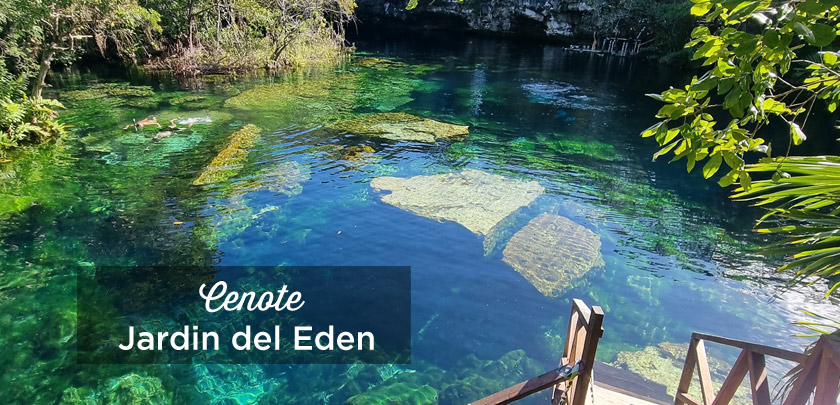
3. Cenote Azul
Best for: Families, first-time visitors and independent half-day trips
Area: South of Playa del Carmen
Style: Open cenote with several connected pools
Tour required: No
Time to allow: Two to three hours
Main drawback: Crowded during weekends, holidays and late mornings
Cenote Azul is one of the easiest cenotes to recommend to a mixed group.
Several pools and ledges provide different depths. Some sections are shallow enough for cautious wading, while the main pool provides space for swimming, snorkelling and a designated jump.
The site does not deliver the cathedral-like atmosphere of a closed cave. Its strength is practical accessibility.
Visitors can move between sunlit and shaded areas, watch small fish, sit on submerged limestone and enter without committing to deep cavern water.
Why it works well for families
Cenote Azul offers:
-
shallow sections;
-
relatively straightforward entry;
-
open sky rather than an enclosed roof;
-
basic changing and toilet facilities;
-
equipment rental;
-
a short walk from the entrance;
-
easy access from the Playa–Tulum corridor.
Parents must still supervise children closely. Depth changes are not always obvious, limestone can be slippery, and a clear pool can look shallower than it is.
Getting there
From Playa del Carmen, take a southbound colectivo and tell the driver you need Cenote Azul. The highway stop is close to the entrance.
From Tulum, take a northbound colectivo toward Playa del Carmen and confirm the stop before boarding.
This is one of the few major Riviera Maya cenotes for which public transport is genuinely practical, provided your group can manage roadside boarding and does not carry much equipment.
Read the full Cenote Azul visiting guide.
4. Taak Bi Ha
Best for: Atmospheric cave swimming and photography
Area: Northern Tulum and Dos Ojos corridor
Style: Enclosed cave cenote
Tour required: Rules vary by chosen experience; guided visits are often the most useful option
Time to allow: Two to three hours
Main drawback: Less convenient without a car or arranged transport
Taak Bi Ha offers the enclosed-cave atmosphere many visitors imagine when they hear the word cenote.
A relatively small opening leads into a chamber where blue water, stalactites, columns and reflected light create a more intimate setting than Dos Ojos.
Because the chamber is enclosed, the experience depends less on direct sun than an open cenote. It can therefore work on an overcast day, although heavy rain can still affect roads and access.
Taak Bi Ha feels dramatic without requiring an advanced cave expedition. Visitors remain in a managed section while looking into a wider subterranean environment.
Who Taak Bi Ha suits
Choose it when:
-
you want formations rather than a sunny swimming pool;
-
enclosed spaces do not bother you;
-
you are comfortable in cool, darker water;
-
you want a quieter alternative to the most famous Tulum cenotes;
-
you have a rental car, driver or organised transport.
It is less suitable for:
-
toddlers;
-
nervous non-swimmers;
-
visitors needing easy step-free access;
-
anyone expecting a place to sunbathe;
-
travellers trying to arrive casually by colectivo.
Practical advice
Access is part of the decision. The turnoff lies near other northern Tulum cenotes, but internal roads add time and can be rough after rain.
Confirm whether your ticket includes a guide, life jacket, equipment and transport from the outer entrance. Similar names and multiple ticket points in the wider park area can cause confusion.
GuideCenote Taak Bi Ha Guide: Snorkeling, Diving and Planning Your VisitCenote Taak Bi Ha is a small, dramatic cavern near the Dos Ojos area between Tulum and Akumal. Here is how to plan a visit for snorkeling or cavern diving, what to expect underground, and how to combine it with nearby cenotes.Open
5. Gran Cenote
Best for: A convenient first cenote from Tulum
Area: Road from Tulum to Cobá
Style: Semi-open pools and cave passages
Tour required: No for the normal swimming area
Time to allow: Ninety minutes to three hours
Main drawback: Expensive and heavily visited
Gran Cenote is famous because it combines several things in one manageable stop:
-
proximity to Tulum;
-
clear water;
-
open and covered sections;
-
wooden access;
-
snorkelling;
-
basic visitor facilities;
-
a setting that photographs well.
The main pools sit beneath a mixture of jungle and limestone overhangs. A short covered section gives swimmers a taste of cave atmosphere without requiring a deep underground route.
Small freshwater turtles may be seen, but sightings are never guaranteed. Do not follow, feed or touch them.
Is Gran Cenote overrated?
Not exactly.
Gran Cenote remains attractive and easy to understand. The problem is that many people encounter it at its busiest and most expensive rather than at its best.
At opening time, the water can be calm and the wooden platforms relatively quiet. By late morning, the same compact space may contain tour groups, families, snorkellers and visitors trying to take photographs.
Go early and it can justify its reputation. Arrive around midday during a busy travel period and it may feel like an expensive public pool in a beautiful cave.
Who should choose it
Gran Cenote suits:
-
first-time visitors;
-
families with older children;
-
travellers without a full day;
-
people staying in Tulum town;
-
visitors combining a cenote with Cobá or another stop on the same road.
Travellers seeking greater solitude should consider Carwash, Nicte-Ha or a carefully timed visit to Taak Bi Ha.
Read our detailed Gran Cenote visiting guide.
6. Casa Cenote
Best for: Mangrove snorkelling, introductory diving and an unusual open-water setting
Area: Tankah Bay, north of Tulum
Style: Long coastal freshwater channel
Tour required: No for ordinary swimming; guides available for snorkelling and diving
Time to allow: Two to three hours
Main drawback: It does not resemble the classic circular cenote some visitors expect
Casa Cenote, also called Cenote Manatí, is unlike most entries in this guide.
Instead of descending into a round limestone opening, visitors enter a long, clear channel surrounded by mangrove. The waterway sits close to the Caribbean and forms part of the connection between inland groundwater and the coast.
The setting works particularly well for snorkelling. Roots, fish, submerged vegetation and changes in depth create more variety than a featureless swimming pool.
Casa Cenote is also used for introductory dives. Its open shape, relatively modest depth and access to cavern features make it useful for divers beginning to understand the region's freshwater environments.
Who Casa Cenote suits
It works well for:
-
snorkellers;
-
visitors interested in mangrove ecosystems;
-
people who have already seen a traditional cave cenote;
-
introductory divers;
-
travellers staying in Tankah, Akumal or northern Tulum;
-
groups combining the cenote with a nearby coastal meal or beach stop.
It works less well for:
-
visitors seeking stalactite-filled chambers;
-
travellers expecting absolute silence;
-
families wanting extensive shallow ledges;
-
people uncomfortable sharing a natural waterway with fish and other wildlife.
Wildlife may be present. Never approach, feed or attempt to handle any animal.
Practical advice
Casa Cenote is close to Highway 307 in distance but not directly beside it. The final access toward Tankah Bay makes a taxi, car or arranged driver more practical than a simple roadside colectivo.
GuideCasa Cenote Guide: How to Visit Cenote Manatí Near TulumCasa Cenote, also called Cenote Manatí, is an open, mangrove-lined freshwater cenote near Tankah and Tulum. This practical guide explains the swimming, snorkeling, diving, transport, safety, timing, and nearby combinations that make the visit work.Open
7. Kantun Chi
Best for: A polished multi-cenote day with facilities
Area: Near Puerto Aventuras and Xpu-Há
Style: Cenote park with open and enclosed sections
Tour required: Depends on the ticket and route
Time to allow: Half a day
Main drawback: More expensive and structured than an independent swimming hole
Kantun Chi is useful for travellers who want variety without moving between separate properties.
The park contains multiple cenotes with different degrees of enclosure. Visitors can see sunlit water, cave formations and more atmospheric underground sections within one organised site.
This makes it easier for families and groups whose members want slightly different experiences. One person may prefer open swimming while another wants a guided underground route.
Facilities and organisation also reduce some of the uncertainty found at smaller cenotes. There are clearer arrival procedures, staff and established visitor routes.
The trade-off is cost and atmosphere. Kantun Chi feels like a managed nature attraction rather than an informal local swimming place.
Who should choose Kantun Chi
It suits:
-
first-time visitors wanting several cenote types;
-
families who value facilities;
-
resort guests looking for a substantial half-day activity;
-
travellers who prefer organised entry;
-
visitors who do not want to negotiate transport between multiple sites.
Independent travellers on a tighter budget may prefer one or two of Azul, Cristalino and Jardín del Edén.
Kantun Chi pairs naturally with the Xpu-Há area, but avoid planning a rushed beach stop before the cenote if it means entering the freshwater while covered in sunscreen or body products.
8. Río Secreto
Best for: A premium guided underground river experience
Area: South-west of Playa del Carmen
Style: Guided cave walk and swim
Tour required: Yes
Time to allow: Half a day including orientation and changing
Main drawback: Considerably more expensive than ordinary cenote entry
Río Secreto is not a place where visitors buy a simple swimming ticket and choose a quiet edge of the pool.
It is a guided journey through part of a large cave system containing flooded passages, dry sections, stalactites, stalagmites, columns and mineral curtains.
Visitors wear protective equipment and follow a controlled route in small groups. Depending on the programme, sections involve walking, wading and swimming through cool water.
The operation describes a wider cave network of approximately 38 kilometres, with only a limited portion used for visitor routes.
Limestone formations inside Río Secreto
Is Río Secreto worth the price?
It can be, provided you understand what you are buying.
The cost reflects:
-
guided access;
-
controlled group sizes;
-
specialist equipment;
-
changing facilities;
-
conservation management;
-
transport options on some packages;
-
access to formations not visible at an ordinary open cenote.
It is not the best value for someone who simply wants to swim for an hour.
It is a stronger choice for visitors who want to understand the underground landscape rather than view a cenote only from the surface.
Who it does not suit
Río Secreto may be unsuitable for people with severe claustrophobia, mobility limitations that make uneven cave terrain difficult, or young children below the operator's current minimum age.
Confirm health, age, mobility and photography rules before booking.
9. Chaak Tun
Best for: A guided cave experience close to Playa del Carmen
Area: Western outskirts of Playa del Carmen
Style: Guided cave and cenote circuit
Tour required: Yes
Time to allow: Around half a day including transfers
Main drawback: Structured rather than independent
Chaak Tun is one of the most practical cave experiences for travellers staying in central Playa del Carmen.
Although it is geographically close to the city, it is not a casual walk from Fifth Avenue. Most visitors use a taxi, included transport or an organised pickup.
The experience usually involves a guide, protective equipment, cave lighting and a set route through chambers containing freshwater and limestone formations.
Chaak Tun makes sense when your group wants a clear beginning and end to the activity. There is no need to decide where to swim, rent separate equipment or plan several cenotes.
Who Chaak Tun suits
It is a strong option for:
-
travellers without a rental car;
-
visitors based in Playa del Carmen;
-
groups wanting a guided explanation;
-
people seeking cave formations;
-
days when the coast is windy or affected by sargassum;
-
travellers who want a substantial activity without a long transfer south.
It is less compelling for independent swimmers, budget travellers or anyone who would rather spend several hours in an open pool.
10. Nicte-Ha
Best for: A smaller, more delicate open cenote
Area: Dos Ojos and northern Tulum corridor
Style: Open and semi-open cenote
Tour required: Usually not for ordinary swimming
Time to allow: Ninety minutes to two hours
Main drawback: Access can be inconvenient and the site feels less quiet once groups arrive
Nicte-Ha is smaller than Dos Ojos and less imposing than Taak Bi Ha, but that is part of its appeal.
Vegetation and water plants soften the edges of the pool. Early in the day, the setting can feel calmer and more intimate than the major attractions nearby.
This is a place to float, snorkel slowly and pay attention to the water rather than search for jumps or adventure activities.
Who should choose Nicte-Ha
Nicte-Ha suits:
-
couples;
-
photographers;
-
relaxed snorkellers;
-
travellers already visiting the wider Dos Ojos area;
-
visitors who value atmosphere over facilities.
The cenote becomes less convincing when crowded because the swimming area is not enormous. Timing matters.
It also should not be treated as a casual add-on to three other cenotes. A Dos Ojos and Nicte-Ha combination is reasonable. Attempting Dos Ojos, Nicte-Ha, Taak Bi Ha and Gran Cenote in one day is not.
11. Chikin Ha
Best for: A varied circuit and light adventure
Area: South of Playa del Carmen
Style: Several cenotes with open and enclosed sections
Tour required: Depends on the selected package
Time to allow: Three to five hours
Main drawback: Packages may include activities you do not particularly want
Chikin Ha brings several cenote environments together on one property.
One section is relatively open, another more enclosed, and another may be approached through a more structured circuit. Packages can include activities such as cycling or zip lines in addition to swimming.
For some travellers, this is efficient. For others, it adds cost and turns a simple cenote day into an adventure-park itinerary.
Who Chikin Ha suits
Choose it when:
-
your group wants more than swimming;
-
you prefer one admission and one property;
-
older children or teenagers need variety;
-
you are staying in Playa del Carmen, Puerto Aventuras or the resort corridor;
-
you have transport included or arranged.
Avoid choosing it solely because a package advertises the greatest number of activities. Read what is included and decide whether you genuinely want each component.
12. Cenote Carwash
Best for: A natural open setting, snorkelling and experienced swimmers
Area: Tulum–Cobá road
Style: Open cenote with cave connections
Tour required: No for surface swimming
Time to allow: Ninety minutes to two hours
Main drawback: Basic facilities and less predictable surface conditions after weather
Cenote Carwash is also known as Aktun Ha.
The English nickname dates from a period when local drivers reportedly used the accessible water beside the road for washing vehicles. The modern visitor experience is very different, but the informal name remains.
The cenote is an open pool bordered by vegetation. Lily pads and plant growth can give it a more natural appearance than highly managed sites.
Divers use deeper sections and cavern routes, while surface visitors can swim and snorkel within the designated area.
Why choose Carwash
Carwash works for visitors who:
-
prefer a less polished setting;
-
are confident in deeper water;
-
want to avoid the most famous Tulum stop;
-
plan to travel along the road to Cobá;
-
enjoy observing plants and fish.
After heavy rain, open cenotes can contain more organic material or tannin-stained water. This does not automatically make the water unsafe, but the appearance may differ from promotional photographs.
Facilities are limited compared with Gran Cenote or the larger parks.
13. Cenote Calavera
Best for: A short, social swim and designated jumping
Area: Just outside Tulum on the Cobá road
Style: Circular semi-open cenote
Tour required: No
Time to allow: One to two hours
Main drawback: Small space, social-media crowds and limited calm
Calavera means “skull.”
Viewed from above, the main opening and two smaller holes are said to resemble the shape of a skull. Visitors enter from a ladder or jump through designated openings when conditions and current rules permit.
The cenote is distinctive and close to Tulum, which has also made it popular with groups filming jumps and taking photographs.
Circular opening at Cenote Calavera near Tulum
Is Calavera worth visiting?
Yes, for the right reason.
Calavera is a good short stop when you want a lively swim rather than an extended nature experience. It can be enjoyable with friends and works well for confident swimmers comfortable entering deeper water.
It is not the best option for:
-
small children;
-
nervous swimmers;
-
anyone seeking a large pool;
-
travellers wanting silence;
-
visitors who dislike waiting while other people pose near the entrance.
Arrive early. Because the usable area is compact, even a moderate number of visitors changes the atmosphere.
GuideCenote Calavera Guide: How to Visit Tulum’s Skull CenoteCenote Calavera is Tulum’s compact, adventurous cenote, known for its three roof openings, deep clear water, and optional jumps. Plan the visit with practical advice on transport, swimming, diving, timing, safety, and nearby alternatives.Open
14. Cenote Cristalino
Best for: A straightforward and relatively affordable open cenote
Area: Beside Cenote Azul, south of Playa del Carmen
Style: Open and partly covered pool
Tour required: No
Time to allow: Ninety minutes to two hours
Main drawback: Similar to nearby alternatives and busy on peak days
Cristalino belongs to the convenient group of cenotes along Highway 307 near Puerto Aventuras.
It offers clear open water, shaded sections, rock edges and a manageable swimming area. The overall experience is simpler than Dos Ojos or Kantun Chi, but that can be a strength.
You arrive, pay, change and swim. There is no required storytelling, equipment package or long circuit.
Cristalino, Azul or Jardín del Edén?
Choose:
-
Cristalino for a compact and simple swim;
-
Azul for mixed-depth pools and family convenience;
-
Jardín del Edén for a larger open-water experience and stronger snorkelling.
The three are close enough that transport should not determine the choice. Your group’s swimming ability and preferred atmosphere matter more.
15. Cenotes Casa Tortuga
Best for: A managed multi-cenote circuit near Tulum
Area: Highway 307 north of Tulum
Style: Four-cenote property with optional activities
Tour required: The cenote circuit is managed and guided according to the selected package
Time to allow: Three to five hours
Main drawback: Commercial atmosphere and package structure
Casa Tortuga combines four named cenotes on one property: Campana, Wisho, Dorca and Tres Zapotes.
The current official offering includes a basic cenote visit and higher-priced packages adding activities such as zip lines, ATVs or meals. At the time of this update, the operator listed daily hours of 9:00 a.m. to 5:30 p.m. and a basic package from 650 MXN.
Those details can change. Check the direct rate and inclusions before travelling.
What to expect
Casa Tortuga is not a quiet roadside cenote.
Visitors move through an established circuit. The property is designed to process groups and sell different activity levels. That makes it practical but removes some spontaneity.
The advantages are:
-
several cenote types;
-
equipment and staff;
-
one arrival point;
-
easy-to-understand packages;
-
enough activity for a substantial half-day;
-
no need to organise separate admissions.
The disadvantages are:
-
higher total cost than a simple cenote;
-
tour-group rhythm;
-
possible waiting;
-
activities that may feel added for packaging rather than necessity.
Casa Tortuga is useful for a family or group that wants an organised day. Independent travellers interested only in swimming may get better value elsewhere.
16. Aktun Chen
Best for: A nature-park cave tour near Akumal
Area: Akumal and Chemuyil corridor
Style: Dry cave, underground water and organised nature attraction
Tour required: Guided components are central to the experience
Time to allow: Half a day
Main drawback: Park format and higher cost than independent entry
Aktun Chen combines a cave system with a broader nature-park experience.
The cave formations are the principal reason to visit. Walking routes reveal chambers formed during the long dry history of the cave, while the underground water section gives context to how those spaces later flooded.
Aktun Chen can be a sensible alternative for travellers staying in Akumal or an isolated resort who do not want to travel all the way into Tulum or Playa del Carmen.
Who it suits
It works well for:
-
visitors interested in geology;
-
families wanting a managed attraction;
-
resort guests needing a predictable half-day;
-
travellers who want more than open swimming;
-
groups combining cave scenery and nature interpretation.
It is less suitable for people who simply want inexpensive water access.
Compare package inclusions carefully. Transport, equipment, photographs, food and additional activities may be priced separately or bundled differently.
17. Ruta de los Cenotes near Puerto Morelos
Best for: A self-drive or private-driver cenote day
Area: Inland from Puerto Morelos
Style: Dispersed route with open, cave and adventure-park cenotes
Tour required: Not always, but transport is important
Time to allow: Half or full day
Main drawback: The route is spread out and difficult to use efficiently without a vehicle
The Ruta de los Cenotes runs inland from Puerto Morelos toward Leona Vicario.
It is not one attraction and it is not a compact walking route. It is a road corridor containing independently operated cenotes, parks, zip lines, ATV businesses and small adventure centres.
Common names include:
-
Cenote La Noria;
-
Cenote Kin Ha;
-
Cenote Zapote;
-
Siete Bocas;
-
Lucero Verde;
-
Las Mojarras;
-
Boca del Puma.
Each has a different character.
La Noria
La Noria is known for an enclosed chamber with an opening in the roof, hanging roots and strong visual contrast between rock, water and sunlight.
It suits visitors seeking a cave atmosphere without travelling toward Tulum.
Kin Ha
Kin Ha is an enclosed cenote with roof openings that can create shafts of light at favourable times.
The experience is often sold as part of a wider activity package. Confirm whether you are buying cenote access alone or a combination including zip lines or ATVs.
Zapote
Zapote is particularly interesting to divers because of unusual bell-shaped mineral formations found underwater. Surface visitors should not expect to see the same details without diving.
Siete Bocas
Siete Bocas takes its name from multiple openings into the same broader system. It has a more rustic reputation than some heavily packaged parks, but current access and management should be checked before travelling.
How to plan the route
Choose one main cenote and one optional second stop.
Do not set out with a list of six. Distances, check-in, changing and separate admission fees quickly consume the day.
A rental car or private driver is the most practical arrangement. Public transport is not designed for visitors moving between scattered entrances.
Read our Puerto Morelos travel guide when deciding whether the inland route fits your wider itinerary.
GuidePuerto Morelos Travel Guide: Beaches, Reef, Cenotes & Where to StayPlan a Puerto Morelos trip with practical advice on beaches, reef snorkeling, the Ruta de los Cenotes, hotels, restaurants, transport, sargassum, costs, and day trips.Open
18. The Cobá cenotes
Best for: Combining an inland cave swim with the Cobá archaeological zone
Area: Near Cobá, west of Tulum
Style: Enclosed and semi-enclosed cenotes
Tour required: No for ordinary entry, though local arrangements vary
Time to allow: Add two to three hours to a Cobá day
Main drawback: Too far for a cenote-only trip from most northern bases
The cenotes near Cobá are not within the narrow coastal Riviera Maya corridor, but they are among the most logical inland additions to a trip from Tulum.
The best-known are:
-
Choo-Ha;
-
Tankach-Ha;
-
Multum-Ha.
Choo-Ha
Choo-Ha is reached by descending stairs into an enclosed chamber filled with stalactites and stalagmites.
The water occupies the floor of the cave, producing a markedly different experience from the open pools near Playa del Carmen.
Cave chamber and water inside Cenote Choo-Ha near Cobá
Tankach-Ha
Tankach-Ha has a larger vertical chamber and is associated with high jumping platforms. Visitors do not need to jump and should only use designated platforms when confident and when current rules allow.
Multum-Ha
Multum-Ha is largely enclosed and reached by a descending staircase. A central platform provides access to the water.
Combining the cenotes with Cobá
Visit the Cobá archaeological zone early, eat locally, and choose one cenote afterward.
Two can be manageable if your group moves efficiently. Three usually adds repetition without substantially improving the day.
Stairway descending into Cenote Choo-Ha
Other cenotes worth knowing
Several other cenotes are important even if they are not the best general recommendation.
The Pit
The Pit is one of the region’s major diving sites.
Its deep chamber, vertical light and halocline create a dramatic underwater environment. It is not a casual swimming recommendation and should be visited through a reputable dive operator.
Tajma Ha
Tajma Ha is known primarily for cavern diving. Light effects and passages can be excellent when conditions align.
Surface visitors should choose a cenote designed for swimming rather than visiting solely because divers praise it.
Dreamgate
Dreamgate contains dense cave formations and is principally a specialist cavern-diving site.
Buoyancy control is essential because careless fin movement can damage formations and disturb sediment.
Angelita
Angelita is known among experienced divers for its deep hydrogen-sulphide cloud, which creates the visual impression of an underwater river.
This is not a beginner dive or an ordinary snorkelling stop.
Cenote Yax-Kin
Yax-Kin is often promoted for families because of shallower water and organised facilities. It can be useful for nervous swimmers but may feel less natural than Azul or Cristalino.
Cenote Corazón del Paraíso
The heart-shaped outline is the main visual attraction. Evaluate current access, management and transport before travelling specifically for an aerial shape that may not be obvious from water level.
Best cenotes by where you are staying
The Riviera Maya is long enough that a good recommendation changes by base.
From Playa del Carmen
The most efficient independent options are south of the city along Highway 307:
-
Cenote Azul;
-
Cristalino;
-
Jardín del Edén;
-
Kantun Chi;
-
Chikin Ha.
Chaak Tun and Río Secreto are useful guided options closer to Playa.
For one straightforward half-day, choose Azul or Jardín del Edén.
For a guided cave experience, choose Chaak Tun or Río Secreto.
For a wider comparison, read Best Cenotes near Playa del Carmen.
GuideChichén Itzá Day Trip from Playa del Carmen: Transport, Tickets & What to SeeHow to visit Chichén Itzá from Playa del Carmen: transport options (tour, ADO bus, rental car), entrance fees, site highlights, and practical tips for a smooth day trip.Open
From Tulum
Tulum has the greatest range of famous cenotes within practical day-trip distance.
Good options include:
-
Gran Cenote;
-
Calavera;
-
Carwash;
-
Dos Ojos;
-
Nicte-Ha;
-
Taak Bi Ha;
-
Casa Cenote;
-
Casa Tortuga;
-
the Cobá cenotes.
For a first visit with easy logistics, choose Gran Cenote at opening time.
For cave snorkelling, choose Dos Ojos.
For a more atmospheric cave, choose Taak Bi Ha.
For a natural open setting, choose Carwash.
For a structured family circuit, choose Casa Tortuga.
Our Tulum travel guide explains how the town, beach road and surrounding routes fit together.
From Akumal
Akumal is well positioned between the Playa and Tulum clusters.
Strong choices include:
-
Dos Ojos;
-
Taak Bi Ha;
-
Nicte-Ha;
-
Casa Cenote;
-
Aktun Chen;
-
Chikin Ha;
-
Kantun Chi.
This is one of the better bases for travellers planning several nature activities. The difficulty is that many hotels described as being in Akumal are isolated along the highway rather than within the village.
A taxi from a resort can be expensive. Ask for the return price before leaving or arrange a driver for several hours.
GuideBest Beaches Near Akumal: Your Guide to Akumal Bay, Half Moon Bay, Jade Bay, South Akumal & Xpu-HaDiscover the best beaches near Akumal, Mexico, from the turtle-filled waters of Akumal Bay to the tranquil shores of Jade Bay and the pristine sands of Xpu-Ha. This guide covers access, facilities, snorkeling opportunities, and practical tips for each beach.Open
From Puerto Aventuras
Puerto Aventuras sits close to the easiest open-cenote cluster.
Prioritise:
-
Cenote Azul;
-
Cristalino;
-
Jardín del Edén;
-
Kantun Chi;
-
Chikin Ha.
These can be reached quickly by car or taxi. Colectivo access is also possible from the highway, although reaching the highway from accommodation inside the development may require a local taxi or walk.
From Puerto Morelos
Use the Ruta de los Cenotes rather than automatically travelling two hours south.
La Noria, Kin Ha, Zapote and other inland sites provide enough variety for a substantial day.
A car or private driver is strongly recommended.
Travellers staying in Puerto Morelos who want Dos Ojos or Gran Cenote should combine the journey with another southern activity rather than travel that distance for one short swim.
From Cancún
Cancún is not the most efficient cenote base, but day trips are possible.
Northern options and the Puerto Morelos route usually make more sense than travelling to the Tulum–Cobá road.
See Best Cenotes near Cancún for a more focused comparison.
From Cozumel
A cenote day from Cozumel requires:
-
travel to the ferry terminal;
-
ferry to Playa del Carmen;
-
onward road transport;
-
the same journey in reverse.
This can work, but it is inefficient for a single short swim.
The easiest choices are Chaak Tun with arranged transport or one of the Highway 307 cenotes south of Playa.
Do not book a distant Tulum cenote unless the trip is part of a wider mainland day.
From an all-inclusive resort
Check the hotel’s exact position rather than relying on the destination name in the booking listing.
A resort marketed as “Playa del Carmen” may be 25 minutes from the city but only ten minutes from Cenote Azul. A property described as “Tulum” may actually sit north of town near Casa Cenote.
Ask the hotel or driver:
-
the distance to the highway gate;
-
whether taxis are allowed to collect guests;
-
the fixed taxi price;
-
whether a return pickup can be arranged;
-
whether the resort excursion includes unnecessary shopping stops;
-
how much cenote time is actually included.
Independent visit or tour?
A tour is not automatically better.
For some cenotes, it adds little beyond transport. For others, the guide and equipment are the entire point of the experience.
Visit independently when
-
the cenote has simple open access;
-
public transport is straightforward;
-
you want to control arrival time;
-
your group is comfortable swimming without instruction;
-
you are visiting Azul, Cristalino or Jardín del Edén;
-
you have a rental car;
-
you only want one or two stops.
Book a tour when
-
the route enters a cave;
-
a guide is mandatory;
-
specialist safety equipment is needed;
-
you are diving;
-
access roads are difficult;
-
your group includes several children;
-
you are staying at an isolated resort;
-
you want Río Secreto, Chaak Tun or a guided section of Dos Ojos;
-
transport planning would otherwise take most of the day.
Questions to ask before booking
Ask the operator:
-
Which exact cenote or cenotes are included?
-
How long is spent in the water?
-
Is hotel pickup included?
-
Does pickup involve many resort stops?
-
Are life jackets, lockers and snorkel equipment included?
-
Is lunch included or merely a shopping stop?
-
How large is the group?
-
Is photography permitted?
-
Is there a separate camera fee?
-
Are there age or mobility restrictions?
-
Is the advertised price the final price?
-
Does the route involve jumping, cycling, zip lines or ATVs?
-
Can unwanted activities be omitted?
Many “cenote tours” are primarily transport packages. Others are genuine guided cave experiences. Read the itinerary rather than relying on the title.
Getting to the cenotes
By rental car
A rental car provides the greatest flexibility.
It works particularly well for:
-
the Puerto Morelos route;
-
Dos Ojos and Taak Bi Ha;
-
a Cobá and cenote day;
-
combining two nearby cenotes;
-
families carrying towels, clothes and equipment;
-
travellers staying at isolated resorts.
Practical precautions:
-
photograph the vehicle before leaving the rental desk;
-
confirm insurance terms;
-
expect unpaved access roads;
-
slow down for potholes and speed bumps;
-
avoid driving unfamiliar rural roads after dark;
-
never leave passports, cameras or luggage visible;
-
retain enough fuel for the return journey;
-
download offline maps;
-
confirm that the mapped entrance is the public ticket entrance.
Do not leave valuables in a parked car simply because a property has an attendant.
By colectivo
Colectivos are inexpensive shared vans running along Highway 307.
They work best for cenotes with entrances close to the highway, including:
-
Azul;
-
Cristalino;
-
Jardín del Edén;
-
some Puerto Aventuras-area properties.
They work less well when:
-
the internal access road is long;
-
you have young children;
-
your group carries several bags;
-
someone has limited mobility;
-
the return requires crossing fast traffic;
-
you need to arrive at an exact reservation time.
Tell the driver the cenote name when boarding. Follow the route on your phone so you understand where you will be dropped.
For the return, wait only at a safe and recognised stopping point. Do not stand in a traffic lane or attempt to flag a van where the shoulder is narrow.
By taxi
Taxis are convenient but prices vary.
Meters are generally not used for these journeys. Agree on:
-
the total fare;
-
whether the price is one way or return;
-
whether waiting time is included;
-
the collection time;
-
the number of passengers;
-
the currency.
Save the driver’s contact details. Small cenotes may not have taxis waiting outside.
A one-way taxi can become expensive when the property lies down a long access road and there is no reliable return vehicle.
By private driver
A driver can be good value for a family or group visiting two cenotes.
The main advantages are:
-
direct hotel collection;
-
no roadside colectivo stop;
-
secure storage between swims;
-
a planned return time;
-
easier child-seat arrangements;
-
flexibility to add lunch or an archaeological site.
Confirm the number of hours, waiting policy, tolls, parking and overtime charge.
By bicycle
Cycling works for only a limited number of cenotes close to Tulum or Playa.
Heat, traffic, poor shoulders and distance can make a route that looks easy on a map unpleasant in practice.
Avoid long Highway 307 rides. Use quieter local roads and purpose-built cycle routes where available.
Bring water, lights and a secure lock. Do not assume the cenote will have a shaded bicycle area.
What cenotes cost
There is no standard entrance price.
A rough planning range is more useful than a fixed list that becomes outdated.
| Experience | Typical planning range |
|---|---|
| Simple independent open cenote | Approximately 150–400 MXN per adult |
| Better-equipped or famous independent cenote | Approximately 300–700 MXN |
| Managed multi-cenote circuit | Approximately 500–1,500 MXN or more |
| Premium guided cave experience | Often 1,500–3,000 MXN or USD-priced |
| Guided cenote snorkelling tour | Varies widely with transport and group size |
| Two-site cenote dive | Often USD 120–220 or more |
| Private driver | Depends on base, vehicle and number of hours |
| Colectivo | Usually the lowest-cost transport option |
| Locker or equipment | Sometimes included and sometimes charged separately |
Prices may differ for:
-
Mexican residents;
-
Quintana Roo residents;
-
children;
-
cash and card payments;
-
direct purchase and tour platforms;
-
basic and premium packages;
-
photography permission;
-
snorkel rental;
-
life jackets;
-
lockers;
-
transport.
Bring Mexican pesos even when cards are advertised. Internet connections and payment terminals can fail.
Do not assume a higher entrance fee guarantees a better natural setting. It may reflect infrastructure, marketing, activities, land access or included transport.
When to visit
Cenotes can be visited throughout the year.
Unlike exposed beaches, they are not directly affected by sargassum. This makes them especially useful during periods when seaweed is accumulating on the coast.
Read our Riviera Maya sargassum guide when planning a warmer-season trip.
Best time of day
For most famous cenotes, arrive during the first hour after opening.
Benefits include:
-
fewer tour groups;
-
calmer water;
-
cleaner platforms and changing areas;
-
easier parking;
-
better wildlife behaviour;
-
more space for snorkelling;
-
less waiting for equipment.
Late afternoon can also be quieter, but only when you have confirmed final admission and closing times.
Do not arrive shortly before closing and expect a full visit.
Weekdays and weekends
Weekday mornings are usually best.
Weekends, Mexican public holidays, Easter, Christmas and school holidays can bring substantial domestic and international visitor numbers.
A cenote that is calm on a Tuesday morning may feel entirely different on a Sunday at noon.
Sunlight and photography
Direct overhead light can create strong beams inside some cenotes. The ideal time depends on the orientation of the opening and season.
Do not organise the entire day around a photograph. Cloud, visitor movement, water disturbance and changing rules can prevent the expected image.
Open cenotes are often pleasant early, before the midday heat. Enclosed cenotes are less dependent on direct sun.
Rain
Ordinary rain does not necessarily prevent a cenote visit.
However, heavy or prolonged rain can:
-
make access roads muddy;
-
increase organic material in open water;
-
reduce visibility;
-
make limestone steps slippery;
-
disrupt electrical systems or tours;
-
cause operators to change routes.
Ask the cenote directly when severe weather has recently affected the area.
Cenote safety
Most managed cenote visits are straightforward, but natural water requires attention.
Water clarity hides depth
Cenote water can be so clear that the bottom looks close.
Do not assume you can stand. Enter cautiously and use a life jacket when required or when you are not a strong swimmer.
Use designated entry points
Jump only from an officially permitted platform after checking the water and current rules.
Never jump:
-
into a cave opening you cannot inspect;
-
from an unofficial rock edge;
-
while another swimmer is below;
-
after drinking alcohol;
-
because other visitors are doing it;
-
when staff have closed the platform.
Enter feet first unless a site explicitly allows another technique.
Do not enter underwater passages
A visible opening does not make a cave safe.
Overhead environments can involve:
-
no direct route to the surface;
-
darkness;
-
disorientation;
-
silt reducing visibility;
-
fragile formations;
-
narrow restrictions;
-
equipment failure;
-
complex gas planning.
Recreational swimmers and snorkellers must remain in designated surface areas.
Follow life-jacket rules
Some cenotes require life jackets for everyone. Others make them optional.
Mandatory jackets may frustrate strong swimmers but help operators control risk and keep visitors from diving into sensitive areas.
Do not remove one in the water if the site requires it.
Watch slippery surfaces
Wet limestone can be extremely slippery.
Use handrails, take small steps and avoid running. Water shoes may help on rough paths, but they do not make polished stone safe.
Protect cuts
Avoid swimming with an open or infected wound.
Natural freshwater is not sterile. Cover minor cuts with a waterproof dressing and seek medical advice for significant wounds or health concerns.
Do not drink the water
The water may look clean, but visitors should not drink directly from a cenote.
Bring your own drinking water and keep it away from the swimming edge where required.
Avoid alcohol before swimming
Some cenote parks sell food and drinks, but alcohol and deep freshwater are a poor combination.
Save alcoholic drinks for after swimming and after any return driving.
Swimming with children
The word “family-friendly” is used too casually.
A cenote may accept children while still involving:
-
steep stairs;
-
deep water;
-
cold temperatures;
-
slippery platforms;
-
limited changing areas;
-
no shallow beach-style entry;
-
long transfers;
-
mandatory life jackets that do not fit every child equally well.
Better choices for children
For younger children and cautious swimmers, consider:
-
Cenote Azul;
-
Cristalino;
-
selected open sections of Kantun Chi;
-
a carefully chosen Casa Tortuga package;
-
Yax-Kin;
-
an organised family tour with suitable equipment.
Gran Cenote can work for older children when visited early.
Dos Ojos is manageable for children comfortable in water, but the cave edges and cool temperature may intimidate some.
Questions parents should ask
Before travelling, confirm:
-
minimum age;
-
child entrance fee;
-
availability of correctly sized life jackets;
-
water depth;
-
type of entry;
-
toilet and changing facilities;
-
whether pushchairs can reach the water;
-
whether food is available;
-
whether the tour includes jumps or zip lines;
-
whether a parent can skip an activity with a child;
-
maximum time underground.
Keep children within arm’s reach near water. A life jacket is an aid, not a replacement for supervision.
Accessibility
Few cenotes are fully accessible.
Promotional descriptions such as “easy access” may mean only that stairs have been installed. They do not necessarily indicate wheelchair access.
Common barriers include:
-
rough limestone;
-
narrow stairs;
-
ladders;
-
muddy paths;
-
uneven platforms;
-
unpaved roads;
-
small changing rooms;
-
no pool hoist;
-
deep-water entry;
-
long distances from parking.
Open parks such as Azul or larger managed properties may be easier than enclosed cenotes, but the final approach to the water can still be difficult.
Ask specific questions rather than asking only whether the attraction is accessible:
-
Is there a step-free route from parking to the water?
-
How many stairs are involved?
-
Is there a handrail?
-
Is there a ramp into the water?
-
Can a wheelchair reach the viewing area?
-
Is there an accessible toilet?
-
Can a companion enter without completing the whole activity?
-
How far is the walk?
-
Are seats available along the route?
Travellers with mobility limitations may still enjoy a cenote from a platform or viewing area, but this varies greatly by property.
Cenote diving
Cenote diving is one of the Riviera Maya’s defining experiences, but the terminology matters.
Open-water diving
Some cenotes contain open areas where a diver can remain beneath open sky or with an unrestricted ascent.
Normal open-water training may be sufficient when the site and operator consider the route appropriate.
Cavern diving
A cavern route enters an overhead environment but remains within the daylight zone and follows strict distance and equipment limits.
Visiting recreational divers generally complete these routes with a qualified local cavern guide.
The guide should explain:
-
route limits;
-
gas management;
-
line procedures;
-
communication;
-
buoyancy;
-
light failure;
-
environmental protection.
Cave diving
Cave diving goes beyond the recreational cavern zone.
It requires specialist training, redundant equipment and detailed procedures. An ordinary Open Water, Advanced Open Water or cavern tour does not qualify someone to explore unrestricted cave passages.
Choosing a dive operator
Ask:
-
What certification is required?
-
What is the maximum group size?
-
Does the guide hold current cave credentials?
-
Are long hoses and redundant lights used?
-
Is equipment included?
-
What tank type is provided?
-
Is nitrox available?
-
Which exact cenotes are planned?
-
Can the route change according to experience?
-
How recently was the equipment serviced?
-
Is insurance required?
-
Is transport included?
-
Are park fees included?
A good operator may decline to take you to a requested site when your certification, recent experience or buoyancy is not suitable.
That is responsible practice, not poor service.
Protecting the caves while diving
Excellent buoyancy is part of conservation.
A fin strike can break a formation that took thousands of years to grow. Poor technique also raises silt, reducing visibility for everyone.
Do not touch the ceiling, floor, guideline or formations except where an emergency procedure requires it.
Environmental rules
Cenotes are vulnerable because the water system is connected.
What enters one part of the aquifer can move beyond the visible pool.
Shower before entering
Most responsible cenotes require a shower.
Remove:
-
sunscreen;
-
insect repellent;
-
perfume;
-
body oil;
-
moisturiser;
-
makeup;
-
hair products;
-
sand and sweat.
The most reliable approach is to use a long-sleeved rash guard, hat and shade before swimming rather than applying a product labelled “biodegradable.”
“Reef-safe” and “biodegradable” are not universal guarantees that a product is harmless in freshwater.
Do not touch formations
Stalactites and stalagmites grow extremely slowly.
Skin oils, impact and repeated handling can damage their surfaces. Do not lean on, climb or hang from formations.
Do not feed wildlife
Fish, turtles, bats and other animals should not be fed or handled.
Feeding changes behaviour and can damage water quality. A business selling fish food does not make chasing or touching animals acceptable.
Do not collect anything
Leave rocks, shells, pottery fragments, bones and other material where they are.
Archaeological or palaeontological objects belong to the site and may be protected under Mexican law.
Keep noise under control
Cave chambers amplify sound.
Shouting, speakers and repeated jump filming can affect wildlife and other visitors. Follow the atmosphere of the site rather than treating every cenote as an adventure park.
Support responsible management
Entrance fees may support staff, land management and local livelihoods, but not every operation applies the same environmental standard.
Positive signs include:
-
mandatory showers;
-
controlled group sizes;
-
clear swimming boundaries;
-
qualified guides;
-
proper toilets and wastewater management;
-
no wildlife handling;
-
no access to sensitive passages;
-
transparent pricing;
-
visible safety procedures.
What to bring
Essential items
-
Mexican pesos in small denominations
-
Swimwear
-
Towel
-
Dry change of clothes
-
Refillable drinking water
-
Well-fitting snorkel mask, when useful
-
Rash guard
-
Water shoes
-
Dry bag
-
Waterproof phone case
-
Any required medication
-
Offline map
-
Driver or taxi contact details
Useful extras
-
Lightweight jumper or spare rash guard for long cave visits
-
Hair tie
-
Small microfibre towel
-
Anti-fog treatment approved for your mask
-
Waterproof dressing for minor cuts
-
Snack for after swimming
-
Portable battery
Leave behind
-
Expensive jewellery
-
Glass bottles
-
speakers;
-
full-size luggage;
-
drones unless written permission has been obtained;
-
regular sunscreen immediately before entering;
-
anything you are unwilling to place in a basic locker.
Photography rules vary. Some properties permit phones and action cameras but charge for larger cameras or prohibit them inside guided caves.
Confirm before carrying expensive equipment.
Suggested cenote itineraries
Half-day from Playa del Carmen
Option 1: Easy independent swim
-
Leave Playa after breakfast.
-
Take a colectivo to Cenote Azul.
-
Swim for two hours.
-
Return to Playa for lunch.
This is the easiest low-planning option.
Option 2: Larger open cenote
-
Arrive at Jardín del Edén near opening.
-
Swim and snorkel for two to three hours.
-
Return by colectivo or car.
-
Spend the afternoon in Playa.
Option 3: Guided cave
-
Book a morning Chaak Tun departure.
-
Complete the guided circuit.
-
Return to Playa for a late lunch.
Do not add another cave simply to fill the day.
GuideChichén Itzá Day Trip from Playa del Carmen: Transport, Tickets & What to SeeHow to visit Chichén Itzá from Playa del Carmen: transport options (tour, ADO bus, rental car), entrance fees, site highlights, and practical tips for a smooth day trip.OpenFull day from Playa del Carmen
Open-cenote route
-
Cenote Azul or Cristalino at opening.
-
Early lunch near Puerto Aventuras.
-
Jardín del Edén for a second, longer swim.
-
Return before evening traffic.
Choose two, not all three.
Managed nature day
-
Morning at Kantun Chi.
-
Lunch on site or nearby.
-
Optional late afternoon at Xpu-Há if conditions are good.
Apply sun protection only after completing the cenote swim.
GuideChichén Itzá Day Trip from Playa del Carmen: Transport, Tickets & What to SeeHow to visit Chichén Itzá from Playa del Carmen: transport options (tour, ADO bus, rental car), entrance fees, site highlights, and practical tips for a smooth day trip.OpenHalf-day from Tulum
Classic first visit
-
Arrive at Gran Cenote when it opens.
-
Swim and snorkel for ninety minutes to two hours.
-
Return to Tulum before late-morning crowds peak.
More natural alternative
-
Visit Carwash early.
-
Spend a relaxed two hours in the water.
-
Continue toward Cobá for lunch or return to town.
Social short stop
-
Visit Calavera early.
-
Swim for one hour.
-
Continue with another activity rather than treating it as a full-day destination.
Full day from Tulum
Cave and open-water contrast
-
Dos Ojos at opening.
-
Lunch after the visit.
-
Casa Cenote later in the day.
This combines a cavern setting with a mangrove-lined waterway.
Northern Tulum cave day
-
Taak Bi Ha in the morning.
-
Nicte-Ha as a quieter second swim.
-
Return to Tulum before dark.
Confirm current ticketing and access-road arrangements.
Cobá and cenote day
-
Leave Tulum early.
-
Visit Cobá before the hottest part of the day.
-
Eat lunch near the village.
-
Choose Choo-Ha or one other nearby cenote.
-
Return before evening.
Read the full Cobá travel guide before setting out.
Half-day from Puerto Morelos
-
Drive inland on the Ruta de los Cenotes.
-
Choose La Noria or another preselected cenote.
-
Swim for two hours.
-
Return to Puerto Morelos for lunch.
A second cenote is optional rather than necessary.
Full day from Puerto Morelos
-
Start with an enclosed cenote such as La Noria.
-
Take a proper lunch break.
-
Visit a contrasting open or adventure-oriented property.
-
Return before rural roads become dark.
Avoid combining the route with Tulum. The transfer defeats the purpose of staying in the northern Riviera Maya.
A cenote day during sargassum season
Keep one inland day flexible in your Riviera Maya itinerary.
Check recent beach conditions after arrival. Use the cenote day when:
-
seaweed is accumulating heavily;
-
the sea is rough;
-
wind makes snorkelling poor;
-
beach cleanup is delayed;
-
the forecast favours an inland morning.
Cenotes are not merely consolation activities. They often become one of the strongest days of the trip.
Common mistakes
Choosing entirely from photographs
Wide-angle lenses, drones and editing can make a small pool look enormous.
Read about the swimming area, access and crowd pattern rather than choosing only by colour.
Arriving at noon
The famous cenotes are often busiest between late morning and early afternoon.
Early arrival improves almost every part of the visit.
Visiting too many
Three or four cenotes in a day sounds efficient on a map.
In reality, each requires:
-
parking or roadside access;
-
ticket purchase;
-
orientation;
-
changing;
-
showering;
-
equipment;
-
swimming;
-
drying;
-
repacking.
Two is normally the sensible maximum.
Assuming “near Playa” means close to the city centre
Many cenotes advertised as being near Playa del Carmen sit 20 to 40 minutes away along Highway 307.
A hotel pickup may involve additional resort stops.
Assuming the highway drop-off is the entrance
A colectivo may leave you at a junction followed by a long, hot or unpaved access road.
Check the full route.
Failing to plan the return
A taxi may deliver you to a remote cenote where no taxis wait.
Arrange a collection time, retain the driver’s number or confirm safe colectivo access.
Trusting an old entrance price
Cenote prices can change quickly.
Confirm direct admission, mandatory equipment and cash policy shortly before travelling.
Wearing sunscreen into the water
Even products marketed as environmentally friendly should normally be removed before entering.
Use clothing and shade before the swim.
Ignoring children’s confidence
A child who enjoys a hotel pool may still dislike cold, deep water beneath a cave roof.
Choose the environment, not merely the age policy.
Confusing snorkelling with cave exploration
A mask does not make an overhead passage safe.
Stay inside marked swimming areas.
Leaving valuables in the car
A locked rental car is not a secure luggage room.
Travel light and use a locker when available.
Booking an activity bundle without reading it
ATVs, zip lines and shopping stops may consume more time than the cenote itself.
Buy the experience you actually want.
Expecting solitude at a famous site
Dos Ojos, Gran Cenote and Calavera are established attractions.
They can still be worthwhile, but timing matters more than romantic expectations.
Frequently asked questions
Which is the best cenote in the Riviera Maya?
For cave snorkelling and a strong first major experience, Dos Ojos is one of the best choices.
For open-air swimming, choose Jardín del Edén.
For families, Cenote Azul is usually easier.
For a premium guided cave, choose Río Secreto.
The best option depends on your base, swimming ability, budget and tolerance for crowds.
Which cenote is best for families?
Cenote Azul is one of the most reliable family choices because it has open sky, shallow sections and relatively simple access.
Cristalino and selected areas of larger managed parks can also work.
Check current life-jacket sizes, depth and child-age rules directly.
Which cenote is best near Playa del Carmen?
Cenote Azul, Jardín del Edén and Cristalino are the most practical independent choices.
Chaak Tun is better for a guided cave experience close to the city.
Río Secreto is the stronger premium underground option.
Which cenote is best near Tulum?
Gran Cenote is the easiest classic choice when visited early.
Dos Ojos is better for substantial cave snorkelling.
Taak Bi Ha has a stronger enclosed atmosphere.
Carwash is better for a more natural open setting.
Is Dos Ojos better than Gran Cenote?
Dos Ojos is generally better for cavern scale, snorkelling and diving.
Gran Cenote is closer to Tulum town and easier to fit into a short morning.
Dos Ojos requires more transport and usually costs more once the full visit is considered.
GuideCenote Dos Ojos: Complete Visiting Guide for Tulum TravellersEverything you need to know to visit Cenote Dos Ojos near Tulum — entry fees, snorkelling vs diving, how to get there, and practical tips for avoiding crowds.OpenIs Gran Cenote worth visiting?
Yes, particularly at opening time.
It becomes less convincing when crowded because the swimming area is relatively compact and the entrance is not inexpensive.
Can I visit cenotes without a tour?
Yes.
Cenote Azul, Cristalino, Jardín del Edén, Gran Cenote, Calavera and Carwash can normally be visited independently.
Guided operations such as Río Secreto and Chaak Tun require their organised format. Diving always requires the appropriate certification and guide arrangements.
Can I reach cenotes by colectivo?
Some cenotes beside Highway 307 are easy to reach by colectivo.
Azul, Cristalino and Jardín del Edén are among the better choices.
Other properties have long access roads beyond the highway, making a taxi, car or tour more practical.
How many cenotes should I visit in one day?
One substantial cenote is enough for a half-day.
Two contrasting cenotes work well for a full day.
Three is possible but often repetitive. Four is rarely a good use of time.
Are cenotes safe?
Managed cenotes are generally suitable for visitors who follow the rules.
The main risks are deep water, slippery limestone, jumping, poor supervision and entering restricted cave areas.
Use a life jacket when needed and remain inside designated swimming zones.
Are cenotes cold?
Most cenote water feels cool compared with the Caribbean.
A typical range is roughly 24–26°C, although conditions vary. The first entry can feel sharp after standing in hot weather.
A rash guard helps during longer cave swims.
Are cenotes fresh water?
Most surface swimming areas contain fresh groundwater.
Near the coast, salt water may lie beneath the freshwater layer. Divers can see the halocline where the two meet.
Can non-swimmers visit cenotes?
Yes, but choose carefully.
Some cenotes have viewing platforms, shallow ledges and mandatory life jackets. Others involve immediate deep water, ladders or cave routes.
Cenote Azul is generally easier than Calavera or a deep diving cenote.
Can I wear sunscreen in a cenote?
You should shower off sunscreen, insect repellent, oils and cosmetics before entering.
A rash guard, hat and shade are better forms of protection before the swim.
Apply sunscreen after leaving the cenote when continuing to an outdoor activity.
Do cenotes have crocodiles?
Wild animals can enter natural waterways, especially mangrove-connected environments.
Sightings are uncommon at most tourist cenotes, and operators manage swimming areas according to local conditions.
Never approach, feed or chase wildlife. Follow staff instructions immediately if an animal is present.
Are cenotes affected by sargassum?
No. Sargassum accumulates in the sea and on beaches.
Cenotes are inland freshwater features, making them a useful alternative when coastal conditions are poor.
Do I need water shoes?
They are useful at many cenotes because paths and limestone can be rough or slippery.
Some guided cave operators provide footwear or have rules about what can be worn. Check before arriving.
Should I bring snorkel equipment?
Bring a well-fitting mask when snorkelling is important to you.
Rental equipment is widely available but quality and fit vary. Fins may be prohibited in order to protect formations and reduce sediment disturbance.
Do cenotes accept cards?
Some do, but cash remains important.
Payment terminals can lose connection, and equipment or locker charges may be cash-only.
Carry Mexican pesos in small denominations.
Are cenotes sacred?
Some cenotes had ritual importance, and many were essential water sources.
Their archaeological and cultural histories vary. It is inaccurate to describe every cenote as a sacrificial site.
All should be treated respectfully as natural water systems and places connected to local communities.
Can I visit a cenote when it rains?
Usually, yes.
Enclosed cenotes can work particularly well on overcast days. Heavy rain may affect access roads, visibility, steps and tour operations, so check directly after severe weather.
GuideCasa Cenote Guide: How to Visit Cenote Manatí Near TulumCasa Cenote, also called Cenote Manatí, is an open, mangrove-lined freshwater cenote near Tankah and Tulum. This practical guide explains the swimming, snorkeling, diving, transport, safety, timing, and nearby combinations that make the visit work.OpenWhat is the best cenote for diving?
Dos Ojos is one of the strongest choices for a first guided cavern dive.
The Pit is a major deeper site for suitably experienced divers.
The best choice depends on certification, recent diving, buoyancy and comfort in overhead environments.
Do I need cave-diving certification?
Not for an ordinary guided recreational cavern route that your certification and the operator permit.
You do need specialist cave training to go beyond the cavern zone into unrestricted cave passages.
How far in advance should I book?
Simple independent cenotes often do not require advance booking.
Reserve earlier for:
-
Río Secreto;
-
private guided cave tours;
-
cenote diving;
-
Christmas and New Year;
-
Easter;
-
large groups;
-
private transport;
-
limited-capacity photography or specialist routes.
Always confirm current opening days before a special journey.
The bottom line
A good cenote day should not feel like a race through a checklist.
Choose one experience that fits your base and group.
For most first-time visitors:
-
Dos Ojos is the strongest cave-and-snorkelling choice.
-
Jardín del Edén is the best substantial open pool.
-
Cenote Azul is the easiest family recommendation.
-
Gran Cenote works well from Tulum when visited early.
-
Taak Bi Ha offers a stronger enclosed-cave atmosphere.
-
Casa Cenote provides the most unusual open-water setting.
-
Kantun Chi is useful for a managed multi-cenote day.
-
Río Secreto is the premium guided underground experience.
-
The Puerto Morelos route is best explored with a car or driver.
-
Choo-Ha is the natural addition to a Cobá day.
Transport and timing matter as much as appearance.
A modest open cenote reached early can be more rewarding than a famous cave visited at its busiest. A guided route can justify a higher price when it provides real access, interpretation and safety. A public-transport saving may not be worth it when the final road is long and your group includes children.
Go early. Carry pesos. Shower before entering. Do not touch formations or wildlife. Stay inside the designated swimming area.
Above all, remember that the visible pool is only an opening into a much larger water system beneath the peninsula.
For quick route questions, use the free Riviera Maya Guide WhatsApp assistant.
Travellers who want help comparing transport, child-friendly access, resort pickup or a realistic multi-stop day can use the Trip Plan and Human Support service.
Sources and further reading
Cave-system lengths and connections continue to change as surveying progresses. Current technical context can be checked through:
