

Cenote Taak Bi Ha is one of the more specialized cenote stops on the Riviera Maya. It sits in the Dos Ojos area on the jungle corridor between Tulum and Akumal, rather than in either town center, and its appeal is concentrated underground: a narrow entrance, a cavern with delicate limestone formations, clear freshwater, and a quieter, more technical feel than the easiest open swimming cenotes.
It can work for a confident snorkeler, but it is especially interesting to divers who understand cavern procedures and can control their position in shallow water around fragile formations. It is not the simplest choice for a family that wants a broad, sunny swimming hole, and it is not a place to treat as an unplanned roadside swim. Access, operator arrangements, cash, stairs, and changing conditions all deserve attention before you leave your hotel.
This guide explains what the visit is like, how to choose between swimming, a guided snorkel, and cavern diving, how to reach the Dos Ojos area, what to bring, and how to build a sensible day around Taak Bi Ha without confusing it with Cenote Dos Ojos or the other nearby sites.
Quick answer
| Question | Practical answer |
|---|---|
| Where is Taak Bi Ha? | In the Dos Ojos cenote area on the federal highway corridor between Tulum and Akumal, in Quintana Roo. |
| Is it in Tulum town? | No. It is associated with the Tulum area for travel planning, but the cenote is outside the town center in the jungle corridor. |
| Who will enjoy it most? | Snorkelers comfortable with a cave-like setting and certified cavern divers with strong buoyancy control. |
| Can beginners swim there? | Swimming access may be available, but the steep entrance, darker environment, and formations make it less forgiving than an open cenote. Verify current conditions and supervision locally. |
| Do you need a car? | A car, taxi arranged in advance, or organized tour is easier. Public transport does not take you directly to the cenote entrance. |
| How long should you allow? | Allow several hours for the cenote itself, plus transfer time. Divers should plan around their guide and equipment schedule rather than a rushed sightseeing itinerary. |
| What is the main drawback? | Operational details and prices change, and the entrance road and stairs require more planning than a town beach or an accessible open cenote. |
The short version is simple: choose Taak Bi Ha for a close-up cavern experience, not because it is the most convenient place to spend a casual afternoon in the water. If you are staying in Playa del Carmen or central Tulum, it is a dedicated excursion. If you are already traveling between Tulum and Akumal, it becomes much easier to fit into the route.
What makes Cenote Taak Bi Ha different?
Taak Bi Ha is a cave cenote whose Maya name is commonly translated as “hidden water route.” The name fits the approach. From the surface, the most memorable part of the experience is not a wide turquoise pool spread across the jungle, but the descent into a more enclosed limestone space. A small opening and steep steps lead down toward water and a dry cavern area. Artificial lighting can reveal the cave’s formations, while natural light is more limited than at an open cenote.
The formations are the reason to slow down. Stalactites hang from the ceiling, stalagmites rise from the floor, and columns appear where mineral deposits have grown together over long periods. These features are fragile. A hand placed on a formation, a fin striking a ledge, or poor buoyancy can cause damage that cannot be repaired on a visitor’s timescale. The right attitude is closer to entering a protected cave than visiting a swimming pool.
Taak Bi Ha is also connected to the extensive Sac Actun cave system. Names and measurements used for the connected system have changed as exploration and mapping have developed, so it is better not to build a travel decision around a single headline distance. The stable point for visitors is that this is part of a major underground water network, and the cenote is a serious cave-diving environment even when the dive itself is shallow.
 Clear water and limestone at nearby Cenote Dos Ojos, a separate cenote in the same Riviera Maya cave region
This image shows the nearby Dos Ojos area, not Taak Bi Ha. The two sites are close in the same cenote corridor, but they are separate visitor experiences.
That distinction matters. Online photos and tour descriptions often group Taak Bi Ha, Dos Ojos, Nicte-Ha, and other cenotes together. They belong to the same broad landscape, but they do not have identical entrances, water layouts, facilities, prices, or rules. Confirm which cenote your reservation names before paying or getting into a vehicle.
Where Taak Bi Ha is located
The cenote is reached through the Dos Ojos area along the Riviera Maya highway corridor. In practical terms, it is south of Playa del Carmen and north of Tulum, with the access road branching inland from the main highway. It is not a walkable attraction from Tulum Pueblo, Akumal Pueblo, or the beach hotel zones.
The exact entrance sequence can be confusing because several cenote businesses and access points operate in the same general jungle zone. Published directions describe using the Dos Ojos access road and continuing beyond the main Dos Ojos parking area before turning toward Taak Bi Ha. Roads can be unpaved, signs may be easy to miss, and local access arrangements can change. Use the directions supplied by the cenote operator or dive guide on the day of your visit rather than relying only on an old map pin.
From Tulum, the journey is normally planned as a drive north along the highway, followed by the turn inland. From Akumal, it is a shorter trip toward the Dos Ojos corridor. From Playa del Carmen, allow enough time for traffic, the highway exit, the slower access road, and the possibility of waiting for your guide or group. The distance is not the only variable; the final approach is what makes a generous schedule worthwhile.
If you are traveling without a car, arrange a taxi or private transfer that is prepared to wait or return at a defined time. A one-way drop-off is not a complete plan if there is no reliable taxi availability at the cenote. An organized cenote or dive trip can remove that uncertainty, especially for visitors carrying dive equipment or traveling with children.
How to get there
By rental car
Driving is the most flexible option for independent travelers. From the highway, follow the current signs and directions for the Dos Ojos area, then use the instructions from the Taak Bi Ha operator. Drive slowly on the unpaved section, leave extra space from vehicles ahead, and expect a rougher surface than the main highway.
Download or save directions before leaving mobile coverage. Do not assume the first cenote sign is your destination. Ask the gate or reception staff to confirm that you are checking in for Taak Bi Ha, particularly if you are using a rental car and the area contains several attractions with similar names.
A car makes it easier to combine Taak Bi Ha with another nearby cenote, but do not overfill the day. Two underground cenotes plus a long drive can become tiring, especially for children or anyone who is not used to cool water, uneven steps, and wet equipment. One main cenote and one simpler nearby stop is usually a more comfortable combination.
By taxi or private transfer
A taxi can work when arranged in advance. Tell the driver the specific cenote, not just “Dos Ojos,” and agree on whether the driver will wait. The route into the jungle and the return pickup are the practical issues. Keep the driver’s contact information available and do not count on finding a new taxi at the site.
A private transfer is useful for a group that wants a fixed pickup, luggage-free travel, or a second stop. It costs more than shared transport, but the value is control over the day. For divers, the ability to carry tanks and equipment without making multiple transport changes is often more important than the lowest fare.
By organized tour or dive guide
A guided trip is the simplest choice for cavern diving. A qualified cenote guide handles the access process, equipment logistics, route planning, and the line-and-light procedures that make an overhead environment different from open-water diving. Ask exactly what is included: transportation, entrance fees, tanks, equipment, guide service, food, and camera fees can be separate.
For snorkeling, a guide is not essential for every visitor, but it can help if you want to understand the cave layout or see formations without wandering into an inappropriate area. A guide also makes the visit easier when the entrance arrangements are unclear or when you are combining Taak Bi Ha with other cenotes.
By colectivo
Colectivos are useful along the main Riviera Maya highway, but they do not function as a door-to-door service to Taak Bi Ha. You would still need to arrange the inland section and the return. Because the final road is not a normal town street and phone coverage or taxi availability may be inconsistent, this is not the most convenient independent plan.
A colectivo can make sense for experienced budget travelers who already know the route and have a confirmed pickup. For a first visit, especially with children, dive gear, or a fixed reservation, a car, transfer, taxi, or tour is more practical.
What the entrance and descent are like
The entrance is part of the experience and part of the screening process. Taak Bi Ha is reached by a steep stairway into a cave-like space. The steps can be wet, and you may be carrying a mask, fins, towel, phone, or camera. Use the handrail where available, keep both hands free when possible, and do not rush to make room for another group.
This access is not ideal for everyone. Visitors with significant mobility limitations should ask the operator for current, specific information before booking. The issue is not only the stairs; it is the transition from the parking area to the water and back up after swimming. Wet surfaces, darkness, and fatigue can make the return more demanding than the descent.
Once below ground, the atmosphere is cooler and darker than on the surface. That can be welcome after a hot drive, but it also changes how children and nervous swimmers react. A child who enjoys a sunny open cenote may find an enclosed cavern less comfortable. Stay close, follow staff instructions, and use a properly fitted flotation aid if you are not a confident swimmer.
Do not apply sunscreen before entering the water unless the operator specifically permits a product. Cenote operators commonly ask visitors to rinse first, and some require biodegradable products or no sunscreen at all. Shower before swimming, leave food and drinks out of the water, and keep loose belongings away from the edge.
Swimming and snorkeling at Taak Bi Ha
Taak Bi Ha can be visited by people who want to swim or snorkel, but it is not a conventional beach-style snorkeling site. The focus is the cavern environment: clear freshwater, rock formations, shadows, and the feeling of moving through a protected underground space.
Visibility is often excellent in cenote water, but clear water does not remove the need for caution. The water can be deep in places, the edges can be irregular, and the ceiling or submerged formations may be closer than they appear from the surface. Keep your body horizontal, use controlled kicks, and avoid touching the limestone.
A mask is more useful than swimming goggles because the main attraction is below the surface. Fins can improve control, but they also increase the risk of striking a formation if you are inexperienced. Ask staff what equipment is permitted and whether flotation vests are required for your activity. Rules may differ between casual swimmers and guided groups.
Snorkelers should stay within the area designated for them. Do not follow a dive line, enter a restricted passage, or swim beyond your guide’s instructions. Cenote diving lines are safety equipment, not a route marker for recreational exploration. If the water feels cold, pause near the entrance, breathe slowly, and let your body adjust rather than forcing yourself farther into the cave.
The best visit is unhurried. You do not need to swim continuously. Float quietly, look upward at the ceiling, and give other visitors space. In a small cavern, one loud or fast-moving group can affect everyone’s experience. The site rewards patience more than athletic swimming.
Is it suitable for children?
It may suit older children who are comfortable in water, can follow instructions, and are not frightened by enclosed spaces. It is less suitable for toddlers, weak swimmers, or children who need a broad shallow area to play. Check current age, life-jacket, and supervision requirements directly with the operator.
Families may prefer a day that combines Taak Bi Ha for adults or confident swimmers with a more open cenote for younger travelers. Cenote Azul near Playa del Carmen, Cenote Jardín del Edén, and other open-water options have a different character; they should not be presented as identical alternatives, but they can make a family itinerary more balanced.
Diving at Taak Bi Ha
Taak Bi Ha is best known among divers for its cavern formations and shallow, delicate environment. “Shallow” does not mean easy. An overhead setting changes the risk profile, and the formations demand precise buoyancy control. A diver who is comfortable in open water but has never trained for a cavern should not improvise here.
Cavern diving requires the diver to remain within the zone where natural light is present, follow a continuous guideline, manage gas conservatively, and stay with a qualified guide. Full cave diving goes beyond that environment and requires separate training. The appropriate certification and experience level should be confirmed with the dive operator before booking, not at the entrance.
Dive descriptions commonly mention an average depth of roughly five metres and a maximum around seven metres, along with water temperatures close to 25°C year-round. Treat those figures as planning references rather than a substitute for a briefing: the exact route, water level, visibility, restrictions, and access arrangements can vary. A wetsuit may still be comfortable because divers spend time in freshwater and often remain relatively still.
Buoyancy is the central skill. You need to keep fins, tank, hoses, and hands away from the ceiling and floor. Do not kneel on the bottom, pull yourself along a formation, or use a rock to steady a camera. If your buoyancy is not reliable, choose an open cenote or book a training session with a dive professional instead.
The steep entrance matters for divers because tanks and gear may need to be moved down and back up. Some operators describe assistance with lowering equipment. Confirm how gear transport works, what the crew charges, and whether you need to carry anything yourself. A small camera can also become an inconvenience in a narrow, fragile space. Ask about camera rules and fees in advance.
 Diver and limestone scenery at nearby Cenote Dos Ojos, illustrating the cavern-diving environment of the Riviera Maya rather than Taak Bi Ha itself
This is a nearby Dos Ojos image, included as regional context. It is not a photograph of Taak Bi Ha, where route conditions and formations should be confirmed with your dive guide.
A good guide will explain the route before you enter, check equipment, establish communication signals, and make it clear when you should stop or turn around. The right day may feel calm and methodical rather than extreme. That is a positive sign in a cave environment.
Facilities and changeable details
Published listings for Taak Bi Ha have not always agreed on opening hours, entrance prices, or whether a particular admission includes a guide. Some descriptions mention toilets, changing areas, showers, and a small shop or visitor service. These facilities can change, and individual dive operators may have arrangements that differ from walk-in visitors.
Verify the following shortly before your visit:
- current opening hours and last admission
- swimming, snorkeling, and diving prices
- whether a guide is required
- accepted payment methods and whether payment is cash only
- equipment rental and flotation-device availability
- camera or video fees
- age, certification, and medical requirements for diving
- road and entrance instructions
- whether the cenote is operating normally after heavy rain or maintenance
Bring Mexican pesos even if a website lists a card option. Cash is useful for entrance fees, tips, parking, lockers, and small purchases, but do not carry more than you need. Keep a dry pouch for your phone and cards, and leave your passport and unnecessary valuables at your accommodation.
Do not assume that a price found in an old article is still valid. Prices in Quintana Roo change, and tour packages may bundle transport or equipment differently. The responsible answer is to verify locally before setting your budget.
What to bring
Pack lightly, but pack for the actual sequence of the day:
- swimsuit and a dry change of clothes
- towel or a compact travel towel
- mask and snorkel if you prefer your own, subject to site rules
- water shoes with a secure sole for wet steps
- cash in Mexican pesos
- refillable drinking water for the surface area
- a dry bag or waterproof phone pouch
- an extra layer for the ride home if you are sensitive to cool air
- reef- and cenote-appropriate personal-care products, used only as permitted
- a small first-aid kit kept out of the water
For diving, use the equipment list supplied by your guide. Do not arrive assuming that every cenote provides the same rental equipment. Certification documents, logbook evidence, dive computer requirements, tanks, lights, wetsuit thickness, and camera rules should be confirmed during booking.
Avoid glass containers, loose jewelry, drones, and large beach bags. The underground space is not designed for clutter. If you are carrying a camera, use a wrist strap and follow instructions about where photography is allowed. A photo is never worth touching a formation or delaying a group.
Safety and cenote etiquette
Cenotes are natural environments with managed access, not swimming pools. Follow the site’s instructions even when the water looks calm. Never swim alone, and do not enter a darker passage because another visitor appears to be doing so. Stay within the designated swimming area unless you are with the appropriate guide.
The “no touching” rule is particularly important at Taak Bi Ha. Limestone formations grow slowly, and oils from skin can affect surfaces. Keep fins away from the ceiling and bottom. If you feel unstable, stop kicking and signal for help rather than grabbing a column.
Do not drink alcohol before swimming or diving. Hydrate on the surface, eat enough before a long activity, and tell the guide if you feel cold, anxious, dizzy, or short of breath. For diving, follow your training and your guide’s gas, depth, ascent, and decompression procedures without exception.
People with medical conditions, recent surgery, pregnancy, severe claustrophobia, or concerns about swimming or diving should seek appropriate professional advice and discuss the situation with the operator. A cenote guide can explain site logistics but cannot replace medical clearance.
Respect the Maya cultural context of cenotes. They are not simply scenic holes in the ground; they are part of the region’s water landscape and have long cultural significance. Keep voices low, do not leave waste, and never remove rocks, fossils, or any object from the site.
The best time to visit
Early arrival is usually the most comfortable strategy. You have a better chance of beginning before the hottest part of the day, and you may encounter fewer groups. Early does not guarantee solitude, especially during school holidays and high season, but it gives you more margin if check-in or the access road takes longer than expected.
The Riviera Maya is warm throughout the year. The underground setting can feel cooler, while the road and parking area can be hot and humid. Rain does not necessarily make a cenote visit impossible, but heavy weather can affect roads, visibility, and operating decisions. Ask before setting out if a storm has passed through.
Seaweed is a major concern for Caribbean beaches in some months, but it does not usually define an inland cave cenote in the same way. That makes Taak Bi Ha a useful alternative on a beach day affected by sargassum. Still, do not treat weather as irrelevant: rain, flooding, and road conditions can matter even when the water is inland.
How long to spend at Taak Bi Ha
For a casual swim or snorkel, plan several hours door to door once you include the drive, check-in, changing, briefing, descent, water time, and return to the surface. The time in the water may be shorter than a full beach afternoon, but the experience is more concentrated.
Divers should plan according to the dive center’s schedule. A cavern dive may be paired with another cenote, and the combination can create a full half-day or day. Do not schedule a flight, an important dinner, or a long intercity transfer immediately afterward. Give yourself room for delays and for the slower pace required by equipment handling.
If you are combining Taak Bi Ha with Dos Ojos, decide whether you want two substantial cenote experiences or one main visit plus a shorter look. Both sites deserve enough time to follow their own rules. Racing through one to reach the other reduces the value of the day and increases fatigue.
What to combine with Taak Bi Ha
Cenote Dos Ojos
Dos Ojos is the obvious nearby comparison, but it is a separate cenote with its own access, routes, and visitor arrangements. It is well known for clear water and cavern scenery and is a natural pairing for travelers who want to compare two different underground environments. Confirm whether your ticket or tour includes both; do not assume that an admission to one automatically covers the other.
Cenote Nicte-Ha
Nicte-Ha is another cenote in the broader Dos Ojos area and is often included in multi-cenote itineraries. Its character differs from Taak Bi Ha, so it can add variety rather than repeating the same enclosed experience. Use it as a comparison only after checking current access and operating details.
Akumal Bay
Akumal is north of the Tulum corridor and is known for organized turtle-snorkeling experiences in protected marine habitat. It is not a spontaneous free-for-all, and visitors should use authorized access and follow wildlife rules. Combining a cenote with Akumal can make a strong water-focused day, but avoid stacking too many activities into one schedule.
Xel-Há
Xel-Há is a managed water park in the same general region. It provides a more structured, facility-heavy day than Taak Bi Ha. Choose it when your group wants food, organized amenities, and a broad range of water activities; choose Taak Bi Ha when the attraction is the cave itself. They are different products, not interchangeable cenotes.
Tulum ruins
The archaeological site at Tulum can be combined with a cenote on a separate day or a carefully timed itinerary. Heat and crowds make an early visit sensible, while a cenote can provide a cooler afternoon. Keep the geography clear: Taak Bi Ha is outside Tulum town, and visiting both requires transport and enough time for each site.
 The open water and limestone landscape at Aktun Chen in Quintana Roo, a different cenote-style attraction from Taak Bi Ha
Aktun Chen is a separate nature park and should not be confused with Taak Bi Ha. It illustrates the broader range of cave and cenote experiences available between Playa del Carmen and Tulum.
Taak Bi Ha compared with easier open cenotes
The easiest way to decide is to compare the shape of the experience rather than chase a ranking.
| If you want… | Consider… |
|---|---|
| A dark, formation-rich cavern | Taak Bi Ha, with appropriate guidance and realistic expectations. |
| A famous nearby cavern site | Dos Ojos, as a separate booking and visit. |
| A more open swimming setting | An open cenote such as Cenote Azul or Jardín del Edén, checking current rules. |
| A family day with extensive facilities | A managed park such as Xel-Há, depending on your budget and interests. |
| A dedicated technical dive | Taak Bi Ha with a qualified cenote dive operator, if your training and experience fit the site. |
| A beach-first day | Akumal, Xpu-Há, or another coastal stop, depending on sea and sargassum conditions. |
Cenote Azul near Playa del Carmen and Cenote Jardín del Edén are often easier choices for visitors who mainly want to swim outdoors. They are not replacements for Taak Bi Ha’s cavern formations, but they may be better for a mixed group with different comfort levels. Likewise, a family should not feel that choosing an open cenote is “settling.” It may simply be the right match for the day.
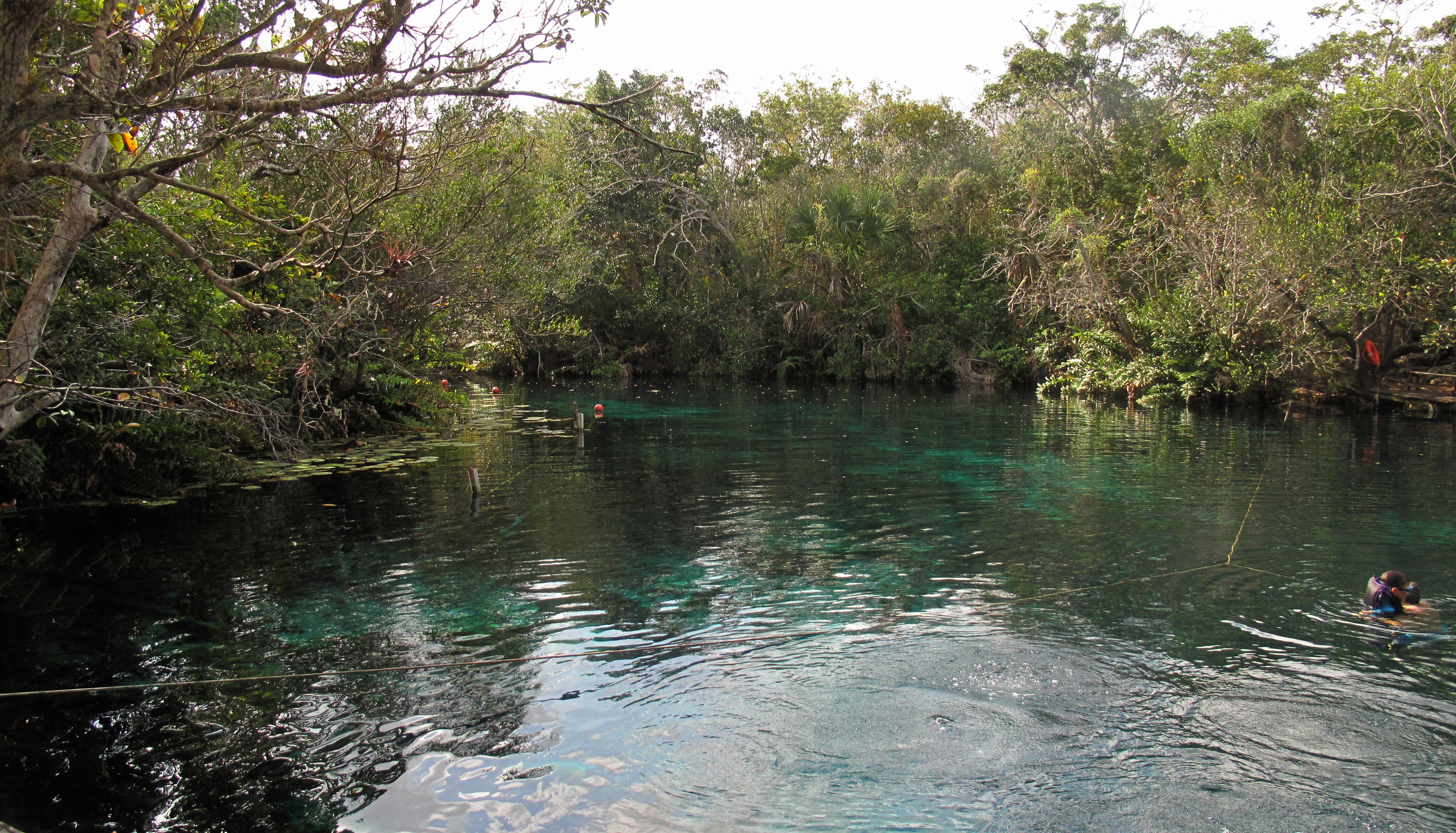 Carwash Cenote in Quintana Roo, another separate inland swimming site that shows the variety of cenote settings in the region
Carwash Cenote is not Taak Bi Ha. Use it only as a visual reminder that Quintana Roo’s cenotes range from open, bright swimming spaces to enclosed cave environments.
Common planning mistakes
Booking the wrong cenote
The Dos Ojos area has several names, entrances, and operators. Read the booking confirmation carefully. If it says only “Dos Ojos area,” ask which cenote you will visit and whether Taak Bi Ha is included.
Treating a cavern as a normal pool
The water may look inviting, but the stairs, darkness, depth changes, and formations require attention. Do not arrive with the expectation of unrestricted jumping, loud play, or exploring every visible passage.
Relying on an old price or schedule
Cenote information ages quickly. Verify on the operator’s current channel shortly before visiting, especially if your itinerary depends on a particular opening time or payment method.
Leaving the return trip until the end
A ride into the jungle is not a guaranteed ride out. Arrange a round trip, book a tour, or confirm the pickup plan before descending.
Overplanning the day
Taak Bi Ha is more enjoyable when you have time to change, listen to the briefing, and move carefully. Avoid adding a distant attraction simply because it appears close on a map.
Touching formations for a photo
This is both environmentally harmful and unnecessary. Use a guide, keep your distance, and accept that the best memory may be the part you did not photograph.
Is Cenote Taak Bi Ha worth visiting?
Yes, if you are specifically interested in a cave cenote and are willing to plan around access and safety. The site offers a more intimate, formation-focused experience than an open swimming cenote, and it is a strong option for qualified cavern divers who want a shallow but technically demanding environment.
It is less compelling if your priorities are convenience, a wide sunlit pool, easy access for a mixed-age family, or a full-service beach day. In those cases, choose an open cenote or managed park and save Taak Bi Ha for a future trip when the group is ready for it.
The most reliable itinerary is modest: arrive early, confirm the exact entrance, carry pesos and water, follow the guide, protect the formations, and leave enough time for the return journey. If you are staying near Tulum or Akumal, pair it with one nearby experience rather than trying to collect every cenote in one day. Taak Bi Ha is at its best when you let the underground setting set the pace.
Frequently asked questions
Is Taak Bi Ha near Tulum or Akumal?
It is in the cenote corridor between the two destinations. Travelers often describe it as near Tulum because it is south of the Akumal area and commonly included in Tulum cenote itineraries, but it is not in Tulum town. Use the actual access directions supplied by your operator.
Is Taak Bi Ha the same as Dos Ojos?
No. They are separate cenotes in the same general area. Their access arrangements, routes, facilities, and prices may differ.
Can I visit without diving?
Swimming and snorkeling may be available, subject to current site rules. The cave setting and steep entrance mean it is not automatically suitable for every swimmer. Ask about supervision, flotation equipment, and current access before arriving.
Do I need cave-diving certification?
For cavern diving, you need the level of training and experience required by the dive operator. Do not confuse ordinary open-water certification with permission to enter an overhead environment. Confirm the requirements before booking.
Is the water cold?
Cenote water is typically cooler than the Caribbean air, and published dive information commonly places the water near 25°C. A wetsuit can be comfortable for divers or anyone spending a long time in the water.
Can I take children?
Older children who swim confidently and follow instructions may enjoy it. Younger children, weak swimmers, and anyone uncomfortable in dark enclosed spaces may be happier at an open cenote. Verify age and life-jacket rules directly.
Can I pay by card?
Payment practices change. Bring pesos and confirm accepted payment methods before traveling. Do not rely on an old blog listing or assume that a tour and walk-in visit use the same payment process.
What should I do if it rains?
Ask the operator whether access is open and whether the road is suitable. A light shower may not prevent a visit, but heavy rain can affect the unpaved approach, visibility, and safety decisions.
How do I protect the cenote?
Shower before entering, use only products permitted by the operator, never touch formations, keep trash out of the water, and follow the designated route. The visitor’s most important contribution is leaving the cave exactly as they found it.
A visit to Taak Bi Ha is not about ticking off another blue-water attraction. It is about entering a delicate underground landscape with enough time, training, and respect to appreciate it. Plan the logistics carefully, keep the day unhurried, and choose a simpler cenote when that is a better fit for the people traveling with you.
 Backup planCenote Dos Ojos: Complete Visiting Guide for Tulum Travellers
 Backup planBest Cenotes Near Tulum: A Practical Guide to Swimming, Snorkeling and DivingBackup planBest Cenotes Near Akumal: A Practical Guide to Swimming, Snorkeling and Cave Adventures